
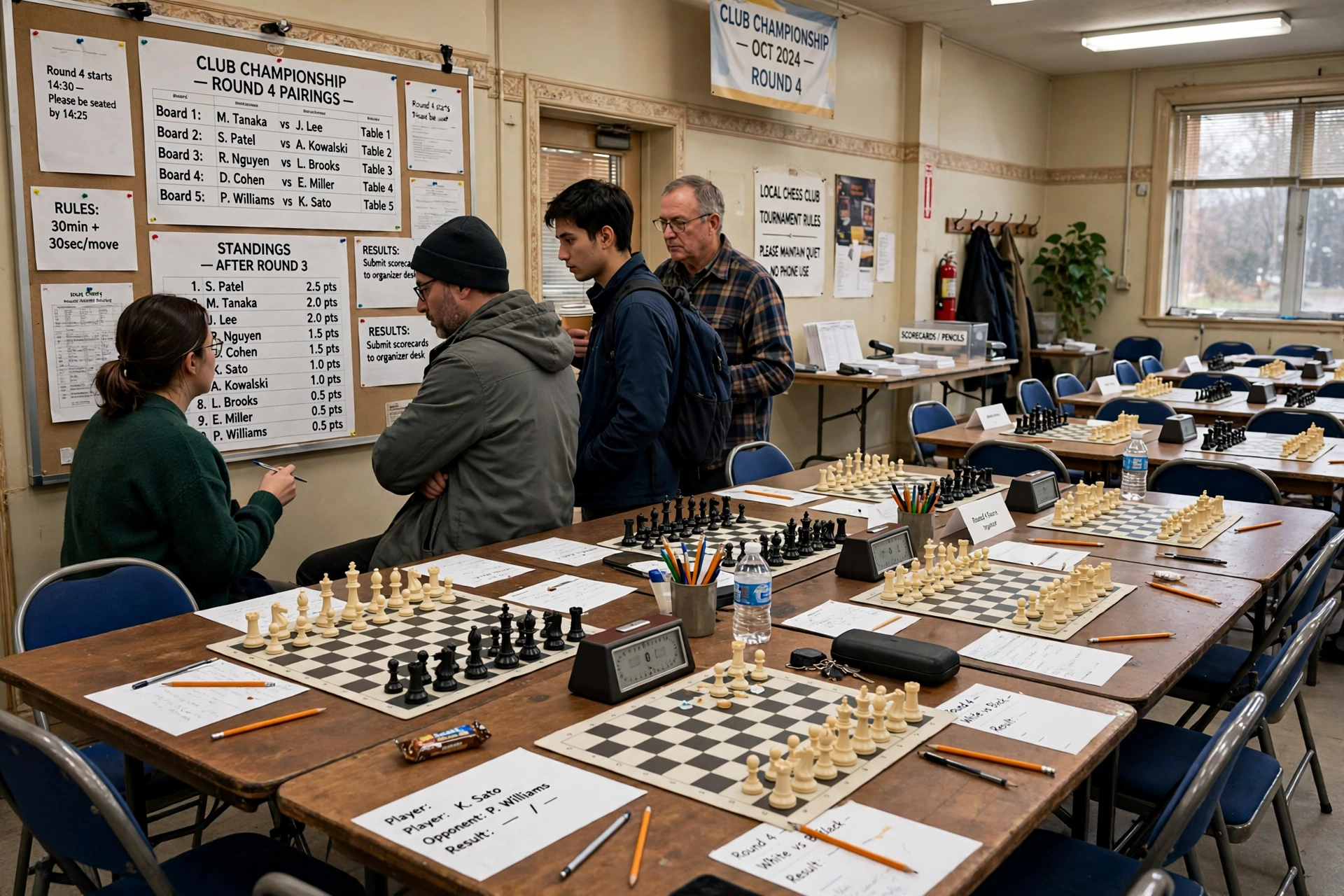
In a Swiss tournament, nobody is ever eliminated. Every player plays every round, winners keep meeting winners and losers keep meeting losers, and after a fixed number of rounds the standings, not a final, decide the champion. It is the format chess clubs have used for a century, and it solves the two complaints organizers hear most: strong players knocked out by one bad game, and weak players sent home before lunch. Here is how the pairings, rounds and tiebreakers actually work.
How many rounds you need
Swiss rounds work like bracket rounds: each round can, at most, halve the number of unbeaten players, so the rounds needed to produce one clear winner roughly equal log2 of the field.
| Players | Swiss rounds |
|---|---|
| 8 | 3 |
| 16 | 4 |
| 32 | 5 |
| 64 | 6 |
Three rounds with 8 players guarantees a single 3-0 finisher at best, and usually exactly one. Add a round if you want cleaner separation in the middle of the table, or drop one for a casual evening and accept a shared first place or a tiebreak. What you cannot do is shortcut it: Swiss standings only mean something once every player has played every round.
The pairing rules
- Round 1 is seeded or random. The common seeded method splits the field in half: top half vs bottom half, so seed 1 plays seed 5 in an 8-player event, 2 plays 6, and so on.
- Later rounds pair equal records. Players on 2-0 play each other, players on 1-1 play each other, and so on down the table. Within a record group, pair by seed or ranking, strongest against strongest of the group.
- Nobody plays the same opponent twice. If the natural pairing is a rematch, swap opponents within the group until it is not.
- Odd groups float. When a record group has an odd number of players, one player floats down to the next group and plays the strongest player there who is not a previous opponent.
- Odd player counts take a bye. With an odd field, one player sits out each round and scores a point for it. Give the bye to the lowest-ranked player who has not already had one.
A worked example: 8 players, 3 rounds
Eight players, seeded in order: Ana, Ben, Cleo, Dan, Elsa, Finn, Gia and Hugo.
Round 1 (top half vs bottom half): Ana beats Elsa, Finn upsets Ben, Cleo beats Gia, Hugo beats Dan. Standings: four players at 1-0 (Ana, Cleo, Finn, Hugo), four at 0-1.
Round 2 pairs inside the record groups: Ana beats Cleo, Hugo beats Finn; and in the 0-1 group, Ben beats Dan, Gia beats Elsa. Standings: Ana and Hugo at 2-0; Ben, Cleo, Finn and Gia at 1-1; Dan and Elsa at 0-2.
Round 3: the title is settled directly, Ana beats Hugo. Below them, Ben beats Cleo and Finn beats Gia in the 1-1 group, and Dan beats Elsa in the 0-2 group. Final standings: Ana 3-0; Hugo, Ben and Finn all 2-1; Cleo, Gia and Dan all 1-2; Elsa 0-3. Check the arithmetic the way any player can: 12 games were played, so the table must hold exactly 12 wins and 12 losses, and it does (3+2+2+2+1+1+1+0 = 12).
Tiebreakers, in plain English
Swiss events nearly always end with a tie like the 2-1 logjam above, so the tiebreaker is agreed before round 1. The standard is Buchholz: add up the final scores of everyone you played. Facing stronger opponents earns you the higher tiebreak. In the example, Hugo’s opponents were Dan (scored 1), Finn (2) and Ana (3), for a Buchholz of 6. Finn’s opponents scored 2, 2 and 1, total 5. Ben’s scored 2, 1 and 1, total 4. So the 2-1 players separate cleanly: Hugo second, Finn third, Ben fourth, and nobody can argue the order was invented after the fact.
For casual events, simpler options work fine. Head-to-head: if the tied players met, the winner of that game ranks ahead (note it fails in three-way ties where the wins form a circle). Cumulative score: add a player’s running total after each round, which rewards winning early; in the example it also puts Hugo (1+2+2 = 5) ahead of Finn (1+1+2 = 4) and Ben (0+1+2 = 3). Pick one, write it on the scoresheet, and do not improvise on the day.
Swiss vs round robin vs elimination
| Factor | Swiss | Round robin | Single elimination |
|---|---|---|---|
| Games with 16 players | 32 (4 rounds x 8) | 120 | 15 |
| Everyone plays | Every round, guaranteed | Every round, guaranteed | Half the field out after one game |
| Champion decided by | Final standings and tiebreakers | Final standings | A final match |
| Best at | Ranked fields, chess-style events, 8 to 64 players | Small fields where everyone should meet everyone | Big fields, short days, a showpiece finish |
Our longer comparison of round robin vs single elimination covers the two bracket formats game by game; Swiss sits between them, delivering round-robin-style fairness for big fields at close to elimination-style cost.
Exact totals for each format and field size are listed in how many games are in a tournament.
Where Swiss struggles
Be honest about the weak spots. With a tiny field, Swiss is overkill: 4 players need only 6 games for a full round robin, so just play one. With one dominant player, the title can be settled a round early and the last round feels flat. Odd fields need a bye every single round, which is manageable but adds admin, and the standings depend on tiebreakers that new players find opaque until someone explains them with their own results, as above. Seeding round 1 fairly matters more than in any other format, so read our guide on how to seed a tournament before you pair strangers by guesswork.
A popular finish is Swiss rounds feeding a small playoff: take the top 4 after the final standings and play semifinals and a final. That playoff is a plain single elimination bracket, and our free Tournament Bracket Generator builds it in a minute from your top four, in standings order. You get Swiss fairness for the field and a proper final for the room.