
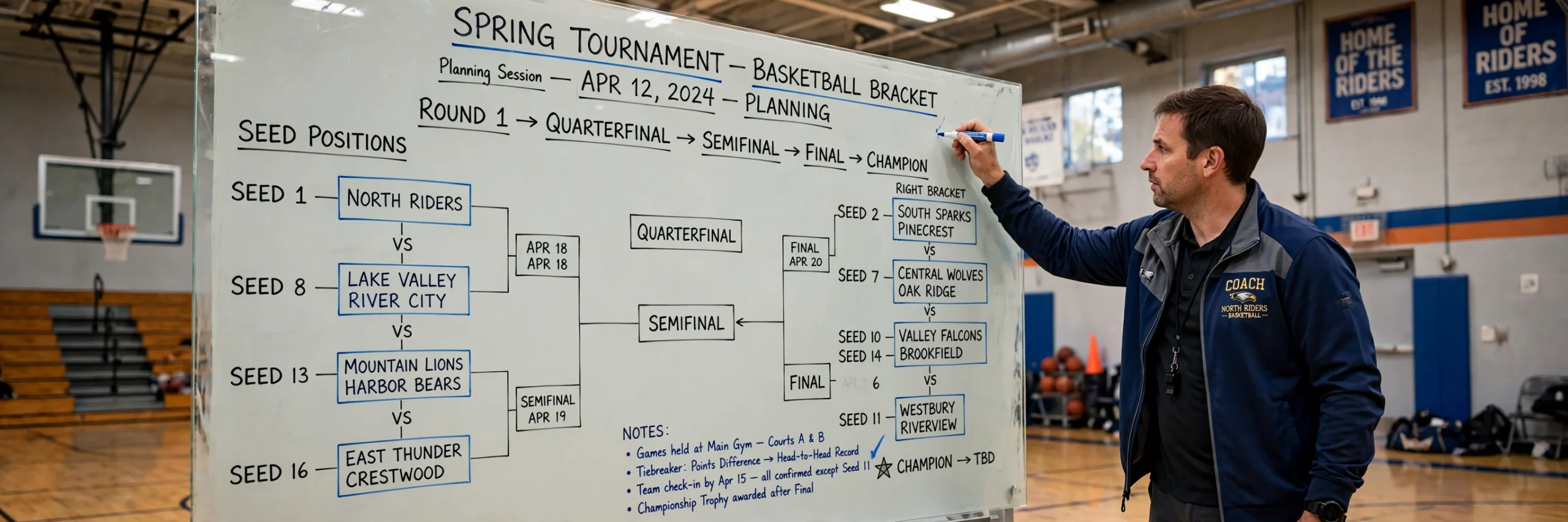
Seeding is the part of running a knockout tournament that sounds like dark magic and is actually simple arithmetic. Done well, it protects the best teams from knocking each other out in round one, rewards the teams that earned it, and produces a final worth watching. Done badly, or skipped, you get the two favourites meeting in the first match and a final nobody cares about. Here is how to seed a tournament properly, with the reasoning shown.
What a seed is
A seed is a team’s ranking position in the draw. Seed 1 is the strongest team, or the team with the best record; seed 2 is next, and so on down to the weakest or least proven entry. Seeding does not change who plays in the tournament. It changes who plays whom, and when. In an unseeded draw, any pairing can happen in any round. In a seeded draw, the pairings are arranged so the highest seeds are kept apart for as long as possible, and only meet when the bracket has narrowed to the stage their ranking deserves.
The pairing logic: 1 plays 8, and pairs sum to size plus one
In an 8-team bracket the first round is always:
- Seed 1 vs Seed 8
- Seed 4 vs Seed 5
- Seed 2 vs Seed 7
- Seed 3 vs Seed 6
Notice two things. First, every pair adds up to 9, which is the bracket size (8) plus one. That rule holds at every size: in a 16-team bracket the pairs sum to 17, so seed 1 meets seed 16, seed 2 meets seed 15, and so on. Second, if the favourites all win, the semi-finals become 1 vs 4 and 2 vs 3, and the final becomes 1 vs 2. The bracket is built backwards from the final you want: the top two seeds are placed in opposite halves so they cannot meet early, the next two are placed so they can only meet the top two in the semis, and the pattern repeats down the rounds. The sum rule is just the tidy way of guaranteeing that, if results follow ranking, every round is as balanced as it can be.
Worked example: 8 teams
Say your eight teams, ranked honestly, are: 1 Northgate, 2 Riverside, 3 Hillcrest, 4 Brookfield, 5 Stonebridge, 6 Kingsway, 7 Eastvale, 8 Marshfield. The quarter-finals are Northgate vs Marshfield, Brookfield vs Stonebridge, Riverside vs Eastvale and Hillcrest vs Kingsway. Northgate, the top seed, gets the weakest opponent; Brookfield and Stonebridge, the middle seeds, get the closest match of the round, which is exactly right, because 4 vs 5 is the pairing where either team winning tells you the least surprising thing. If the top seeds in each match win, the semis are Northgate vs Brookfield and Riverside vs Hillcrest, and the draw has done its job.
Worked example: 6 teams, and where the byes go
With 6 teams the bracket rounds up to 8 slots, leaving 2 empty. Those empty slots are never placed at random: they sit opposite the lowest seeds, which means the byes go to the top seeds. Seeds 1 and 2 rest in round one. The first round is seed 4 vs seed 5 and seed 3 vs seed 6. The winners then meet seeds 1 and 2 in the semi-finals, with seed 1 facing the winner of 4 vs 5. This is the same sum rule working with holes in it: seed 1 was due to meet seed 8, seed 8 does not exist, so seed 1 advances. If you want the full picture of byes at every team count, our explainer on what a bye is in a tournament has the table and the reasoning.
How to rank teams when you have no data
Seeding needs a ranking, and friendly tournaments rarely have league tables. Use whatever honest signals you have, in roughly this order of reliability:
- Last time’s results. The previous tournament or season is the best predictor you have; last year’s finalists are your top two seeds.
- Head-to-head knowledge. If everyone knows two teams are a level above the rest, seed them 1 and 2 and do not overthink the middle order.
- A quick group vote. Ask each team to rank the others (not themselves) and average the answers; the wisdom of the room is usually close.
- A shuffle for the rest. Seed only the teams you are confident about, typically the top two or four, and draw the remaining slots at random. Partial seeding is normal and defensible.
What matters is that the ranking is written down before the draw and shared with everyone. A seeding list people can see is a seeding list people accept.
When to skip seeding: the unseeded draw
Seeding is not always the right choice. For a social tournament where the fun is the point, a fully unseeded draw, every pairing pulled blind, creates giant-killing stories and removes all argument about who ranked whom. Many charity and office tournaments draw unseeded for exactly that reason. The cost is real, though: the final can be one-sided, and your strongest team can go home in round one through no fault of its own. A middle path many organisers use is to seed just the top two or four teams and draw everything else, which protects the final without turning the draw into a spreadsheet. Whichever route you choose, decide before entries close and say so in the rules, so nobody feels the format was chosen after the field was known. For the wider job of running the event itself, dates, formats, fixtures and finals, see our step-by-step guide on how to organize a knockout tournament.
Seeding decisions follow you into every format: Swiss tournaments re-pair by record after every round, and pool play turns pool standings into crossover seeds, so the logic above applies there twice over.
Once your seeds are listed in order, the bracket builds itself: our free Tournament Bracket Generator takes your teams in seed order, applies the standard pairings, hands the byes to the top seeds automatically, and lets you click winners through to the champion.