
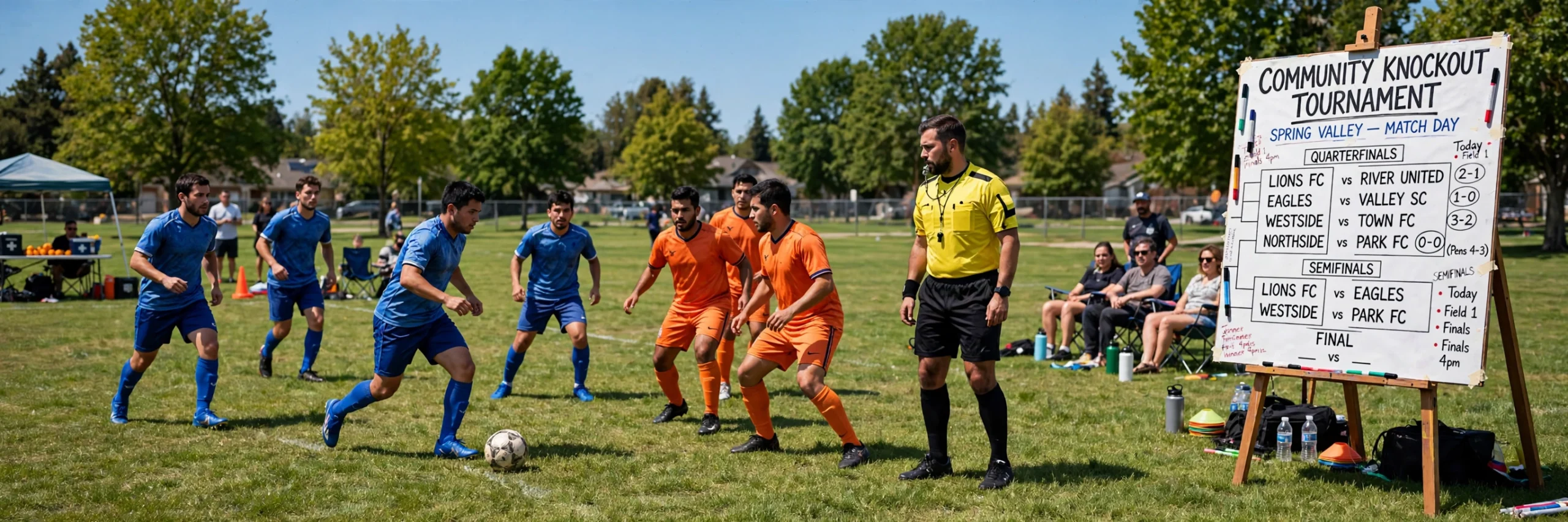
A knockout tournament is the simplest format in sport: lose once and you are out, win and you move on. Organising one is equally simple once you make six decisions in the right order: format, team count, seeding, schedule, dropout rules and the final. This guide works through each decision with the numbers that actually matter, so your bracket runs on time and nobody disputes how it was built.
Step 1: Choose the format honestly
Single elimination is the default for a reason: it needs the fewest matches, produces a champion fastest, and every match matters. Its weakness is just as real. Half your teams go home after one game, which stings at a school fete or a work social. Match the format to the occasion:
- Single elimination. Best for one-day events, large fields and competitive groups. A 16-team bracket is 15 matches total.
- Double elimination. Teams survive one loss and drop into a losers bracket. Fairer, roughly twice the matches, and harder to explain on the day. Use it for small, serious fields.
- Group stage into knockout. Groups of four play round robin, then the top two advance to a knockout bracket. Everyone gets at least three games. Best when the event is the whole point of the day, worst when you are short on time or pitches.
Two second-chance formats deserve their own explainers once the basics are clear: double elimination brackets, where a team is only out after two losses, and consolation brackets, which guarantee every first-round loser a second game.
Step 2: Fix the team count and the bracket size
Brackets are built on powers of two: 4, 8, 16, 32. Count your confirmed teams, then round up to the next power of two to get the bracket size. The gap between the two numbers is filled with byes, free passes into round two for the top seeds. Twelve teams means a 16-slot bracket and four byes. Six teams means an 8-slot bracket and two byes. If the maths of who rests and who plays feels murky, the guide to what a bye is in a tournament lays out the count for every field size from 3 to 16 teams, so you can answer questions before anyone asks them.
Step 3: Seed the teams, or draw them in public
Seeding decides the first-round pairings, and there are only two defensible ways to do it. If you have real rankings, last season’s standings, qualifying results or honest coach assessments, seed by them: seed 1 plays the lowest seed, seed 2 plays the second lowest, and so on. This rewards the strongest teams with the easiest start and keeps the favourites apart until the late rounds, which is where spectators want them.
If you have no rankings, do not invent them. Draw the names in public, from a hat or on a screen, in front of the teams. A visible random draw is unarguable in a way a quiet spreadsheet never is. One practical note: if your “teams” are still a list of individual players, form the squads first with a random team generator, then seed or draw the finished teams. Mixing the two steps is how organisers end up rebuilding the bracket on the morning of the event.
Step 4: Schedule backwards from the final
Work out your match load before you promise start times. A single elimination bracket needs one match fewer than the number of teams: 8 teams, 7 matches; 16 teams, 15 matches. Then cost it out. If a match is 20 minutes plus 5 minutes of changeover, one pitch clears about two matches an hour. A 16-team bracket on two pitches is 15 matches, so roughly four hours of play, plus breaks and the final. Build the schedule backwards from when the venue closes, publish every round’s start time, and protect the turnaround gaps: tired, rushed teams are where injuries and arguments live.
Step 5: The venue and equipment checklist
- Playing surface booked for the full window, including overrun time for the final
- Match balls or equipment, plus at least two spares
- A visible bracket: printed poster, whiteboard or screen, updated after every match
- Scoresheets or one phone per pitch with a named scorekeeper
- Whistles, bibs or coloured bands so teams are distinguishable
- Water, shade and a basic first aid kit
- A PA system or a loud voice plan for announcing the next matches
- Prizes, certificates or a trophy, bought before the day, not during it
Step 6: Decide the dropout rules before the first match
Dropouts are not a risk, they are a schedule item. Write the rules down and share them with entry confirmations. A team that withdraws before the bracket is published gets replaced by a reserve or removed, and the bracket is rebuilt if the team count changes the number of byes. A team that no-shows on the day forfeits: their opponent advances on a walkover. A team that withdraws mid-tournament also forfeits, and their previous results stand. Never rebalance a bracket halfway through to be kind; the teams who played their matches will rightly feel cheated.
Step 7: Run the final like it matters
The final is the product everyone remembers. Give it the best slot, the best surface and a small ceremony: announce the teams, name the route each took to get there, and present the prize immediately after the last whistle while the crowd is still together. Publish the completed bracket the same day, photos included. That finished bracket is also next year’s best advertisement.
Every step above gets easier when the bracket itself is not drawn by hand. The free tournament bracket generator takes your team list, builds the seeded bracket with the byes worked out, and lets you click winners through to the champion, so the poster on the wall and the results on your phone never disagree.