
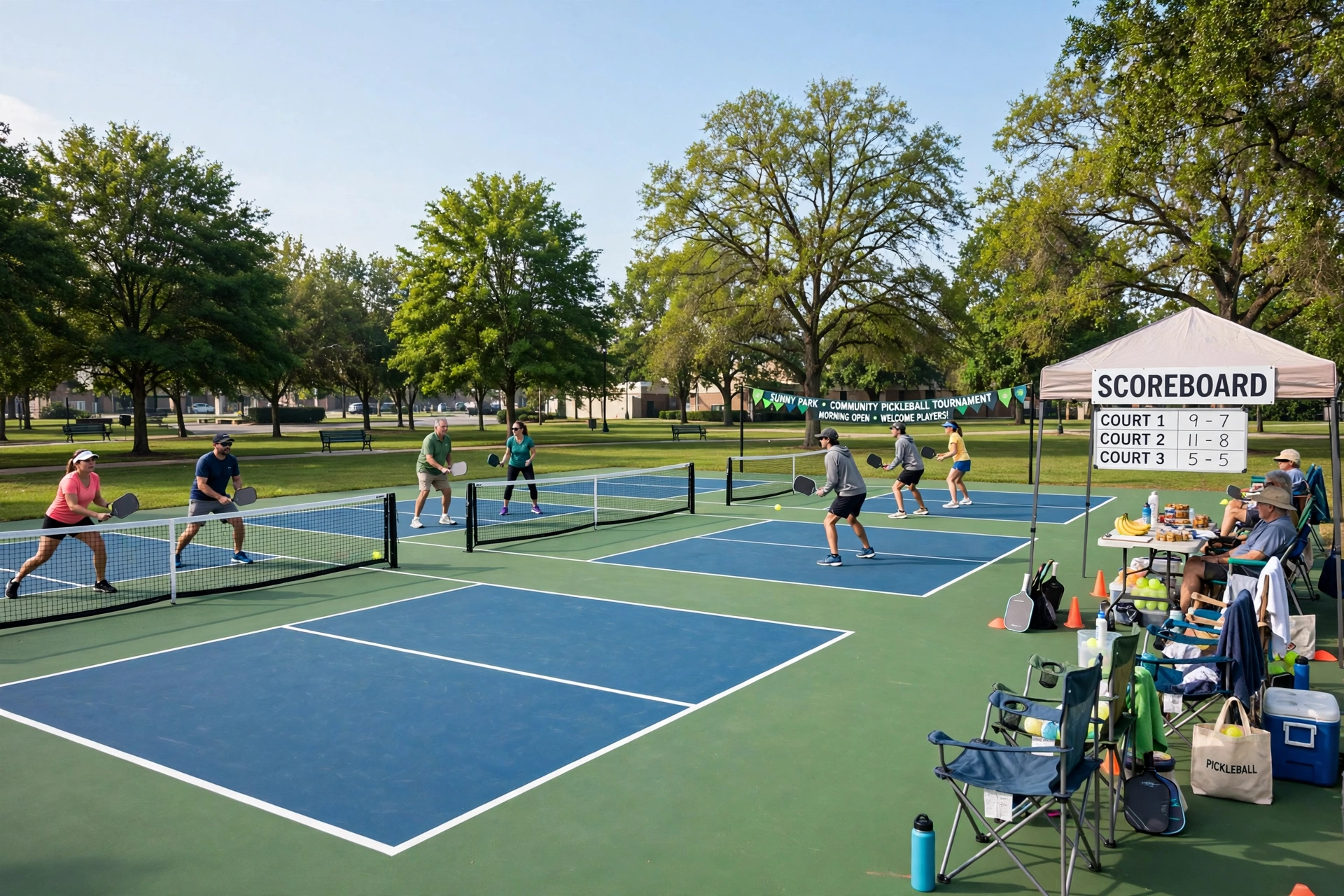
Running a small pickleball tournament comes down to three decisions made in the right order: the format, the court math, and the divisions. Get the format wrong and you promise 60 matches to 4 courts. Get the math wrong and the final starts at dinner. This plan walks through all three with real numbers, then lays out a timeline that runs itself on the day: a 24-player event on 4 courts, finished, with awards, in under five hours.
Step 1: Pick the format from your player and court counts
Most club events are doubles, so this table counts teams. Match counts come straight from the format formulas: a round robin pool of T teams costs T(T-1)/2 matches, and a single elimination bracket of T teams costs T-1.
| Teams | Courts | Recommended format | Total matches |
|---|---|---|---|
| 4 | 2 | One round robin pool, then a final between 1st and 2nd | 6 pool + 1 final = 7 |
| 6 | 2 to 3 | One round robin pool, standings decide | 15 |
| 8 | 2 | Two pools of 4, top 2 in each to a 4-team bracket | 12 pool + 3 bracket = 15 |
| 8 | 4 | One full round robin pool | 28 |
| 12 | 4 | Two pools of 6, top 4 in each to an 8-team bracket | 30 pool + 7 bracket = 37 |
| 16 | 4 to 6 | Four pools of 4, top 2 in each to an 8-team bracket (or double elimination, 30) | 24 pool + 7 bracket = 31 |
| 24 | 6 to 8 | Four pools of 6, top 2 in each to an 8-team bracket | 60 pool + 7 bracket = 67 |
| 32 | 8 | Eight pools of 4, top 2 in each to a 16-team bracket | 48 pool + 15 bracket = 63 |
Two honorable mentions. A compass draw for exactly 8 teams guarantees everyone 3 matches in 12 total: win or lose in round 1, you move east, west, north or south into a new mini-bracket, and every team finishes with a placing. And double elimination suits a competitive 8 to 16 team field that wants a true champion; budget 2N-2 matches and a longer tail at the end of the day.
New to group stages? Pool play explained walks through standings, tiebreakers and crossover seedings with a worked example.
Step 2: The court math, worked in full
A game to 11 typically takes 15 to 20 minutes including the warmup hits nobody admits to taking. Budget a 20-minute slot per match and the day stays honest. The formula is: matches divided by courts, rounded up, times slot length.
Worked example: 24 players, so 12 doubles teams, on 4 courts. Two pools of 6 teams play round robins: each pool costs 15 matches, so 30 pool matches. At 4 courts, 30 matches fill 8 slots (the last slot runs 2 matches), and 8 x 20 minutes = 160 minutes, about 2 hours 40 of pool play. The top 4 from each pool move to an 8-team single elimination bracket: 7 matches, but they arrive in dependency order, quarterfinals, then semifinals, then the final, which is 3 slots, about 1 hour. Total court time for the tournament itself: roughly 3 hours 40. Everything else in the day is people, not math: check-in, announcements and awards.
Step 3: Divisions and honest seeding
Nothing kills a social tournament faster than a 4.5-level pair quietly entering the beginner draw. Split the field before you split the pools. The usual club divisions are skill bands in the self-rated or DUPR style: under 3.0, 3.0 to 3.5, 3.5 to 4.0, and 4.0 plus, with age groups (under 50, 50 plus, 65 plus) layered on when the field is big enough to fill them. A division needs at least 4 teams to be worth running; merge thin divisions rather than canceling them.
Seed inside each pool from what you actually know: last month’s ladder results, club ratings, or the players’ own honest self-rating checked against a regular who has seen them play. Then separate your top seeds across pools so the best teams meet in the bracket, not in game one. Our guide on how to seed a tournament gives the pairing logic, including what to do when you have no data at all: seed the few teams you are sure about and draw the rest in public.
Step 4: Scoring formats that keep the day moving
Traditional side-out scoring to 11, win by 2, is the default for pool play, but a stubborn pool match can run 35 minutes and stall every court behind it. Two controls keep the schedule safe. First, a hard rule agreed in advance: pool matches are one game to 11, bracket matches can be best of 3 games to 11 in the semifinals and final if the math allows. Second, rally scoring to 15 or 21, where every rally scores a point, makes match length far more predictable, which is why many club events use it for pools. Whichever you choose, print it on the scoresheet. Disputes about scoring formats are never really about scoring; they are about a rule surfacing for the first time at 9-9.
Step 5: A timeline that runs itself
For the 24-player, 4-court event above:
| Time | What happens |
|---|---|
| 8:30 | Check-in opens. Teams confirm, get their pool and first court assignment. |
| 8:50 | Welcome, format and scoring rules in two minutes, no exceptions promised later. |
| 9:00 | Pool play starts. Eight 20-minute slots. |
| 11:40 | Pool play ends. Standings posted, bracket announced, short break. |
| 12:00 | Quarterfinals, then semifinals, then the final, one slot each. |
| 13:00 | Final ends. Medals, photos, and the group picture nobody escapes. |
| 13:15 | Done. Courts handed back cleaner than you found them. |
The discipline that makes this work is rotation discipline: when a slot ends, the next four teams are already standing at the court with paddles in hand. Call matches two slots ahead, post the court grid where everyone queues for coffee, and record scores at one desk, never by memory.
Equipment checklist
- Balls: one new ball per court plus spares; a typical club event goes through 8 to 16 balls in a day.
- Nets checked the day before, with a spare net or repair ties if any are portable.
- Two or three spare paddles for the inevitable snapped handle and the guest who forgot.
- Printed scoresheets for every match, clipboards and pencils, plus a paper copy of the pools and bracket.
- A visible standings board or whiteboard, updated after every slot.
- Water, shade, a basic first aid kit, and a whistle or loud voice for slot changes.
A realistic small-event budget
For a typical club event, the honest ranges look like this. Court rental runs from free at public parks to roughly 15 to 30 dollars per court per hour at indoor facilities, which is why outdoor club events are so much cheaper to run. Balls cost about 3 to 4 dollars each bought in multi-packs. Medals run about 3 to 6 dollars each, printing and supplies 20 to 50 dollars total, and a modest prizes-and-snacks line keeps volunteers human. Entry fees at typical club events sit around 15 to 40 dollars per player; at 24 players, even the low end of that range covers balls, medals and printing with room to spare when courts are free.
The bracket stage at the end of the day deserves a proper bracket, not a whiteboard reconstruction: our free Tournament Bracket Generator takes your advancing teams in seed order and builds the single elimination bracket with the pairings worked out. Run the pools on paper if you like, following the step-by-step in our guide on how to organize a knockout tournament, then let the tool draw the final stage cleanly while the players are still catching their breath.