
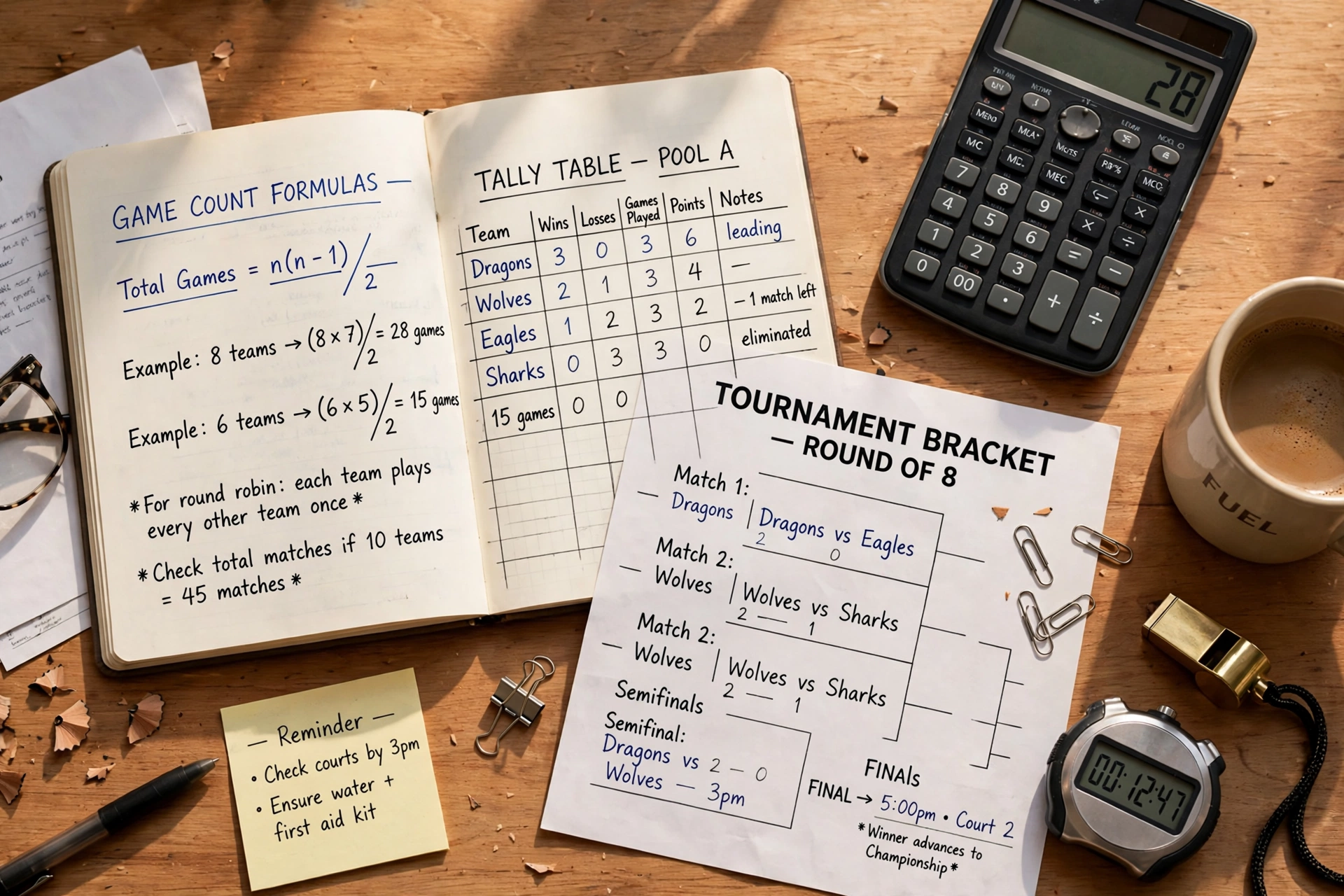
Three formulas answer almost every tournament planning question. A round robin with N teams needs N(N-1)/2 games, a single elimination bracket needs N-1 games, and a double elimination bracket needs 2N-2 games, or 2N-1 with a bracket reset final. Everything below is those three lines worked out in full: a lookup table for 3 to 32 teams, a worked check for each formula, and the step most organizers actually need, turning a game count into hours.
The three formulas, checked with 6 teams
Round robin: N(N-1)/2. Every team plays every other team once. Each of the N teams has N-1 opponents, which gives N(N-1) pairings, and dividing by 2 removes the double count, since A vs B is the same game as B vs A. For 6 teams: 6 x 5 / 2 = 15 games. Count them by hand if you like: team 1 plays 5 games, team 2 adds 4 new ones, then 3, then 2, then 1, and 5+4+3+2+1 = 15.
Single elimination: N-1. Every game eliminates exactly one team, and crowning a champion means eliminating everyone else. Six teams means 5 teams must go home, so 5 games: 2 first-round games (with 2 teams on byes), 2 semifinals and a final, if you run it as a standard 8-slot bracket.
Double elimination: 2N-2, or 2N-1 with a reset. Every team except the champion must lose twice, and the champion may finish with one loss or none. Losses are handed out one per game, so the total is 2(N-1) if the champion is unbeaten, which is 10 games for 6 teams, or one more, 11, when the champion takes a loss and the bracket reset final is played. The full mechanics are in the format guides linked below.
The lookup table: 3 to 32 teams
| Teams | Round robin games | Single elim games | Double elim games | Round robin rounds | Single elim rounds |
|---|---|---|---|---|---|
| 3 | 3 | 2 | 4 | 3 | 2 |
| 4 | 6 | 3 | 6 | 3 | 2 |
| 5 | 10 | 4 | 8 | 5 | 3 |
| 6 | 15 | 5 | 10 | 5 | 3 |
| 7 | 21 | 6 | 12 | 7 | 3 |
| 8 | 28 | 7 | 14 | 7 | 3 |
| 9 | 36 | 8 | 16 | 9 | 4 |
| 10 | 45 | 9 | 18 | 9 | 4 |
| 11 | 55 | 10 | 20 | 11 | 4 |
| 12 | 66 | 11 | 22 | 11 | 4 |
| 13 | 78 | 12 | 24 | 13 | 4 |
| 14 | 91 | 13 | 26 | 13 | 4 |
| 15 | 105 | 14 | 28 | 15 | 4 |
| 16 | 120 | 15 | 30 | 15 | 4 |
| 17 | 136 | 16 | 32 | 17 | 5 |
| 18 | 153 | 17 | 34 | 17 | 5 |
| 19 | 171 | 18 | 36 | 19 | 5 |
| 20 | 190 | 19 | 38 | 19 | 5 |
| 21 | 210 | 20 | 40 | 21 | 5 |
| 22 | 231 | 21 | 42 | 21 | 5 |
| 23 | 253 | 22 | 44 | 23 | 5 |
| 24 | 276 | 23 | 46 | 23 | 5 |
| 25 | 300 | 24 | 48 | 25 | 5 |
| 26 | 325 | 25 | 50 | 25 | 5 |
| 27 | 351 | 26 | 52 | 27 | 5 |
| 28 | 378 | 27 | 54 | 27 | 5 |
| 29 | 406 | 28 | 56 | 29 | 5 |
| 30 | 435 | 29 | 58 | 29 | 5 |
| 31 | 465 | 30 | 60 | 31 | 5 |
| 32 | 496 | 31 | 62 | 31 | 5 |
Two columns deserve a word of explanation. Round robin rounds are N-1 for even fields and N for odd fields, because an odd field needs a bye slot and one team rests each round. Single elimination rounds are the ceiling of log2 N, in plain terms: keep doubling 2, 4, 8, 16, 32 until you cover the field, and count the doublings. Twelve teams needs 4 rounds, because 8 slots are not enough and 16 are.
From games to hours
A game count becomes a schedule with one more line of arithmetic: total court time = games x minutes per game, then divide by the number of courts or pitches running in parallel. Worked example: 12 teams, single elimination, 2 courts, 20-minute games. The bracket has 11 games, so total court time is 11 x 20 = 220 court-minutes. Split across 2 courts that is 110 minutes of wall-clock play, about 1 hour 50 minutes. Add changeovers honestly: if teams need 5 minutes between games, budget 25 minutes per game slot instead. The 11 games then fill 6 waves on 2 courts, and 6 x 25 = 150 minutes, about 2 hours 30 from first game to final whistle. Either way, the honest version of the estimate starts from the game count, not from a guess.
Run the same math for a 12-team round robin and the difference explains itself: 66 games x 20 minutes = 1,320 court-minutes, which on 4 courts is still 330 minutes, five and a half hours of play before changeovers. That gap is the whole format decision, and our side-by-side look at round robin vs single elimination lays out what you get in return for the extra hours.
Games per team
Players experience a format as games per team, not totals. In a round robin every team is guaranteed N-1 games: 7 each in an 8-team league. In single elimination, half the field plays exactly one game, and only the finalists reach the maximum, which for 8 teams is 3 games. Double elimination guarantees everyone at least 2 games, and the champion from the losers bracket can play as many as 7 in an 8-team event. If your players are traveling or paying entry fees, the guaranteed minimum is usually the number that matters most.
Quick answers
Do byes change the single elimination total? No. A bye is an empty slot in the first round, not a skipped game in the count: 6 teams in an 8-slot bracket still play 5 games, because 5 teams still have to be eliminated. The explainer on what a bye is in a tournament shows exactly where those empty slots sit.
What does a double round robin cost? Exactly double the single round robin: every pair meets twice, so 8 teams go from 28 games to 56, and rounds double too.
How do I count pool play? Add the pools up. Each pool is its own small round robin, so four pools of 4 cost 6 games each, 24 in total, then add the playoff bracket on top: an 8-team single elimination adds 7, for 31 games all in.
Two companions to this page: the fixtures themselves are in how to make a round robin schedule, and group-stage events are broken down in pool play explained, standings and tiebreakers included.
When the count says a knockout fits your day, the bracket itself takes a minute to build: our free Tournament Bracket Generator takes your team list in seed order, places the byes, and gives you the full N-1 games as a clickable bracket you can print or copy.