
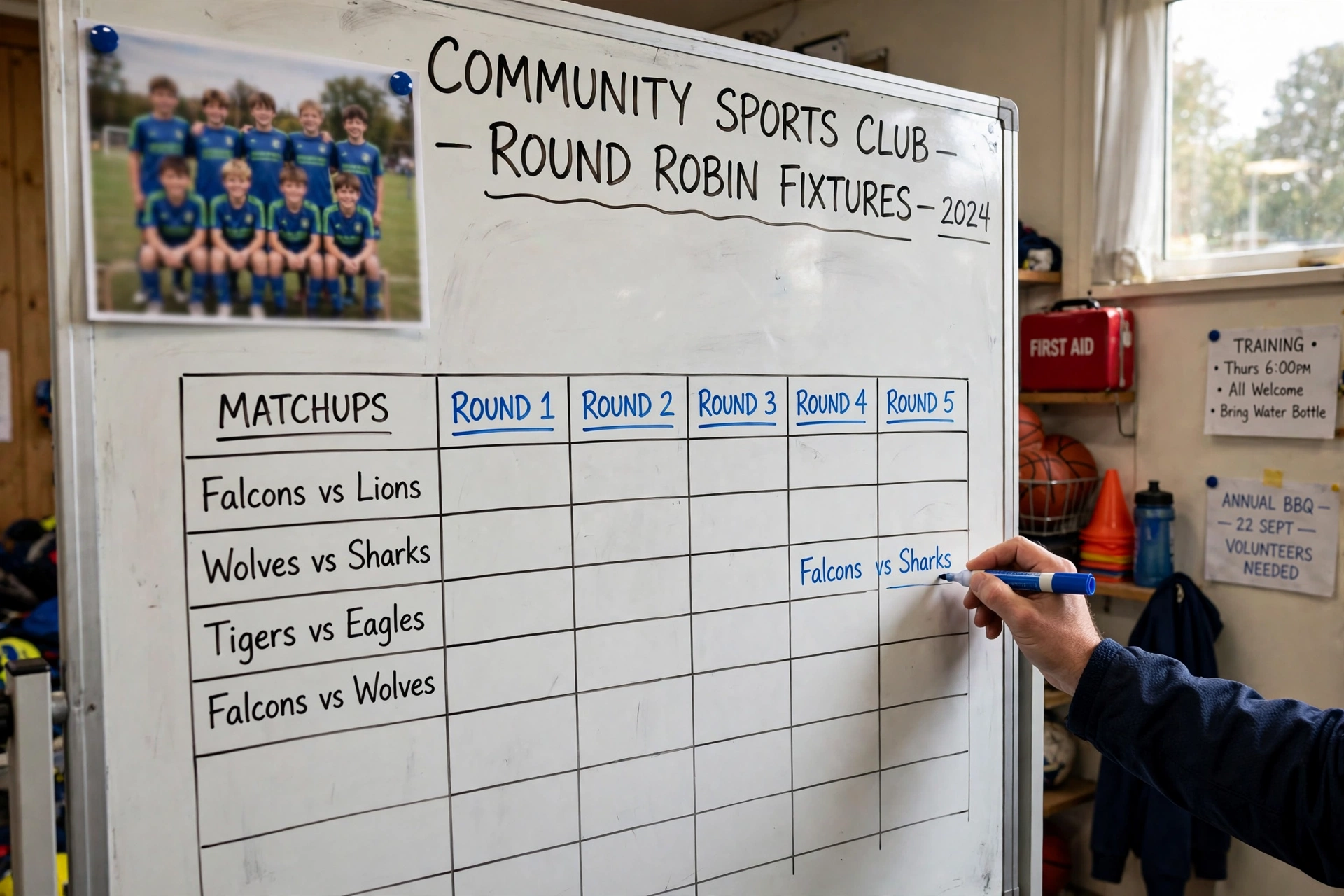
A round robin schedule pairs every team with every other team exactly once, and the fastest way to build one by hand is the circle method: write the teams in a ring, fix one in place, and rotate the rest one step each round. Five minutes with a pencil gives you a complete, correct fixture list for any even number of teams, plus a simple trick for odd numbers. Here is the method, with ready-made tables for 4, 6 and 8 teams that you can copy straight onto your scoresheet.
The circle method in five steps
- Number your teams. Seeds, names or letters all work. The examples below use numbers 1 to 8, so just map your teams onto the numbers once.
- Write them in two rows. For 6 teams: 1, 2, 3 across the top and 6, 5, 4 along the bottom, so the columns read 1 vs 6, 2 vs 5, 3 vs 4. Those columns are your round 1 fixtures.
- Fix the first team. Team 1 never moves. It is the pin the rest of the ring turns around.
- Rotate everyone else one step clockwise. After each round, every team except team 1 shifts one position around the ring. Read the new columns and you have the next round.
- Repeat until the ring returns to the start. With an even number of teams N, you get N minus 1 rounds, and every pairing has happened exactly once. No team ever plays twice in the same round, because the columns always partition the whole set.
That is the whole system. The tables below are exactly what the rotation produces, so you can use them directly and skip the pencil work.
4 teams: 3 rounds, 6 games
| Round | Game 1 | Game 2 |
|---|---|---|
| 1 | 1 vs 4 | 2 vs 3 |
| 2 | 1 vs 3 | 2 vs 4 |
| 3 | 1 vs 2 | 3 vs 4 |
6 teams: 5 rounds, 15 games
| Round | Game 1 | Game 2 | Game 3 |
|---|---|---|---|
| 1 | 1 vs 6 | 2 vs 5 | 3 vs 4 |
| 2 | 1 vs 5 | 4 vs 6 | 2 vs 3 |
| 3 | 1 vs 4 | 3 vs 5 | 2 vs 6 |
| 4 | 1 vs 3 | 2 vs 4 | 5 vs 6 |
| 5 | 1 vs 2 | 3 vs 6 | 4 vs 5 |
8 teams: 7 rounds, 28 games
| Round | Game 1 | Game 2 | Game 3 | Game 4 |
|---|---|---|---|---|
| 1 | 1 vs 8 | 2 vs 7 | 3 vs 6 | 4 vs 5 |
| 2 | 1 vs 7 | 6 vs 8 | 2 vs 5 | 3 vs 4 |
| 3 | 1 vs 6 | 5 vs 7 | 4 vs 8 | 2 vs 3 |
| 4 | 1 vs 5 | 4 vs 6 | 3 vs 7 | 2 vs 8 |
| 5 | 1 vs 4 | 3 vs 5 | 2 vs 6 | 7 vs 8 |
| 6 | 1 vs 3 | 2 vs 4 | 5 vs 8 | 6 vs 7 |
| 7 | 1 vs 2 | 3 vs 8 | 4 vs 7 | 5 vs 6 |
Every table above has been checked pairing by pairing: each team meets each other team once, plays once per round, and finishes with N minus 1 games. The order of games inside a round does not matter, so feel free to reshuffle columns to suit your courts or pitches.
Odd numbers: add a dummy team
With an odd count, add one imaginary team called Bye and run the method as if the field were even. Whoever is paired with Bye simply rests that round. Five teams become a 6-slot ring, 7 teams an 8-slot ring, and the schedule takes N rounds instead of N minus 1. With 5 teams, the resting order across the 5 rounds is: team 1, then team 4, team 2, team 5 and team 3, so every team sits out exactly once and still plays its 4 games. Seven teams need 7 rounds and 21 games, with one team resting per round. The general rule is easy to remember: even fields take N minus 1 rounds, odd fields take N rounds. Ten teams, an even field, take 9 rounds and 45 games, and nobody rests.
Rest fairness is the one thing to check with odd fields. Because the dummy rotates with everyone else, the bye lands on a different team each round and completes a full cycle, which is as fair as a rest can be. If your event runs a second cycle, keep the same rotation and the pattern stays balanced.
Double round robin: mirror the second half
Leagues usually play everyone twice, once at home and once away. Build the first half with the circle method, then repeat the same rounds in the same order for the second half with home and away swapped in every fixture. An 8-team double round robin is 14 rounds and 56 games. Mirroring, rather than reshuffling, keeps the return fixtures evenly spread and guarantees no pair meets twice in quick succession early in the second half. One practical tip: in each fixture, treat the first-named team as the home team. In the mirrored second half the order flips on its own, so every pair gets one home game and one away game without any extra bookkeeping.
When pool play beats one big round robin
A single round robin grows fast: 12 teams means 66 games, and 16 teams means 120. If your field is large or your day is short, split the teams into pools of 4 to 6, run a small round robin inside each pool with the tables above, then send the top one or two from each pool into a knockout bracket. Four pools of 4 need only 24 pool games before the playoffs. Our comparison of round robin vs single elimination walks through the games, time and fairness trade-offs, and our guide on how to organize a knockout tournament covers the bracket stage that follows the pools.
For the numbers behind any of these formats, the companion page how many games are in a tournament lists totals for 3 to 32 teams, and pool play explained covers the group stage in full.
One job comes before any schedule: getting the players sorted into the teams or pools themselves. Our free Random Group Generator splits a list of players into even groups in seconds, with keep-together and keep-apart rules for the pairs you already know about. Form the groups there, number them, and the circle method tables above turn them into a full fixture list.