
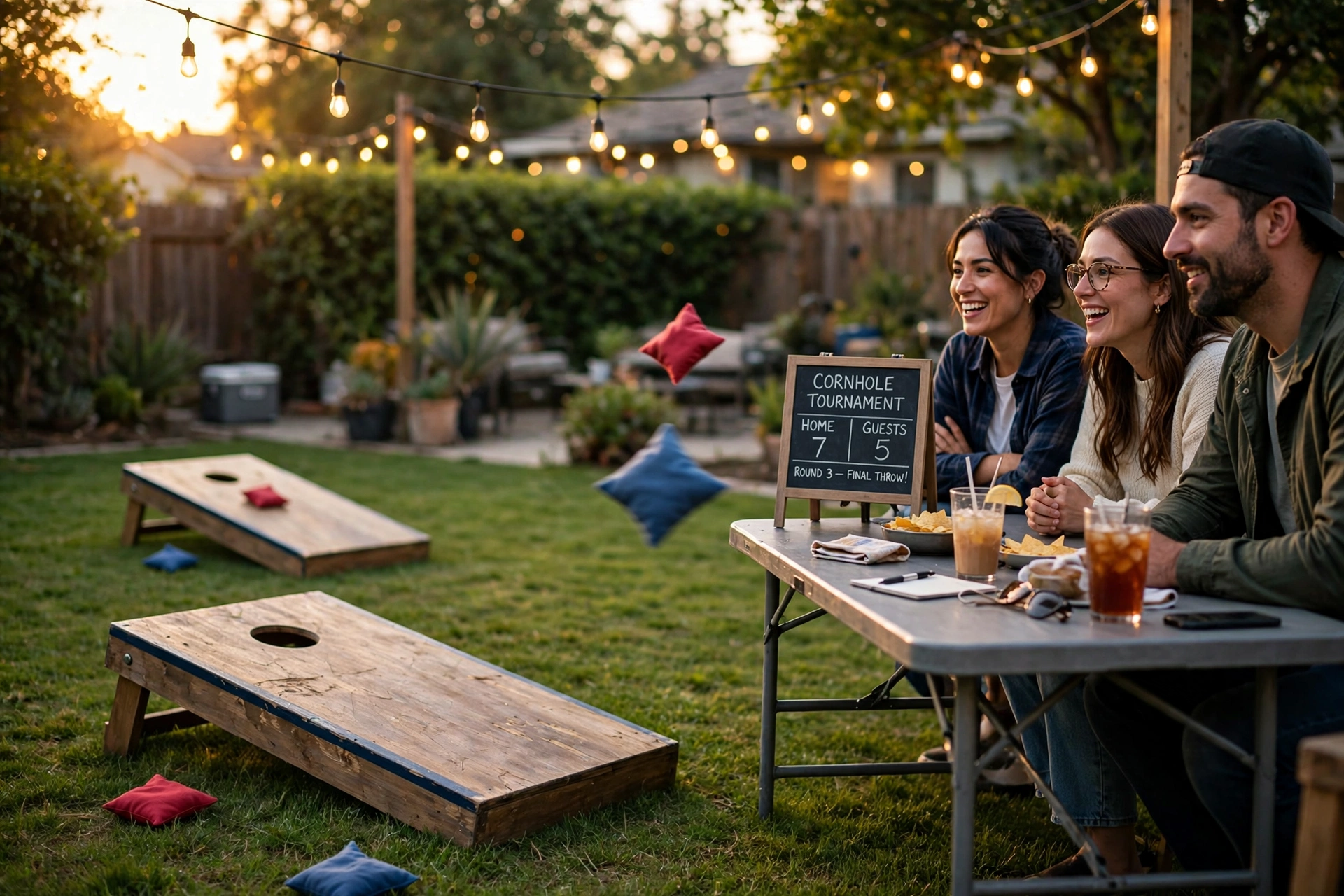
Cornhole tournaments fall apart for predictable reasons: courts squeezed into too little space, a scoring argument in the first game, and semifinals still running at sunset. Four decisions prevent all of it: the court setup, the scoring system, the format, and how you keep games moving. This guide covers all four, with real numbers for fields of 8, 16 and 32 teams.
Set up regulation courts
Regulation play puts the boards 27 feet apart, measured from front edge to front edge. Each board is 2 feet wide by 4 feet long, with a 6-inch hole centered 9 inches down from the top edge. The board’s front edge is the foul line: step past it during a throw and the bag does not count.
Space matters more than most organizers expect. The playing length alone is 27 feet plus the 4-foot board at the far end, and players need standing room behind the boards. Give each court a footprint of roughly 10 feet wide by 40 to 45 feet long. Squeeze courts to 8 feet wide and stray bags start landing in the next lane. Level ground matters more than the surface itself: bags slide further on concrete and check up quicker on grass, but either plays fine if the boards sit flat. Shim a rocking board before game one, not after someone complains.
Indoors, check the ceiling first. A tossed bag arcs high, and under about 12 feet of ceiling the flight runs into lights and beams. Throw one test game at full effort; if the arc is clipped, move outside or accept a flatter, faster game, and tell everyone before the draw.
Bags and basic gear
A set is 8 bags, 4 in each of two colors. Regulation bags are 6 by 6 inches and weigh about a pound each (15 to 16 ounces); resin-filled bags behave more consistently than corn-filled ones in damp air. You also need a tape measure for setup, tape or chalk for foul lines on hard surfaces, a scoreboard or scoresheet on every court, and one spare set of bags, because a burst bag in round two should not stop the tournament.
Scoring: cancellation to 21
Cornhole uses cancellation scoring, and it is the part new players argue about, so explain it before the first pitch. In each inning, the two teams alternate throws until all 8 bags are thrown. A bag left on the board at the end of the inning (a woody) is worth 1 point. A bag in the hole, whether thrown in or knocked in (a cornhole), is worth 3. A bag that touched the ground before the board, or was thrown on a foul, is worth 0 and is removed at once.
Then the cancellation: only the difference between the two totals is scored. Worked example. Team A throws two bags in the hole (6 points), one on the board (1 point) and one off the back (0), for a total of 7. Team B throws one in the hole (3), one on the board (1) and two short of the board (0), for a total of 4. Seven minus four is three, so Team A banks 3 points for the inning and Team B banks none. First team to 21 wins.
Settle the house rules in writing before the draw:
- Straight 21 or win by 2? Straight 21 keeps the schedule predictable. Win by 2 is fairer and slower.
- Bust rule? Some groups send a team over 21 back to 11 or 15 points: fun in the backyard, a schedule killer with 16 teams. Skip it.
- Skunk rule? An optional mercy rule: an 11 to 0 lead after a completed inning ends the game. Useful when courts are scarce.
Pick a format that fits your clock
The format decides your finish time more than any other choice, so count the games before you commit. A casual game to 21 runs about 15 to 20 minutes.
| Teams | Single elimination | Double elimination | Pools of 4 + playoff |
|---|---|---|---|
| 8 | 7 games | 14 games | 15 games |
| 16 | 15 games | 30 games | 31 games |
| 32 | 31 games | 62 games | 63 games |
The pools column is the pool games (12, 24 and 48 for 8, 16 and 32 teams) plus a playoff bracket for the top two from each pool (3, 7 and 15 games). Double elimination assumes no reset final; if the unbeaten finalist loses the grand final and you play a deciding game, add one.
Turn games into hours with one sum: games divided by courts gives you waves, and waves times 20 minutes gives you a realistic clock. A 16-team single elimination bracket is 15 games; on 4 courts that is 4 waves, roughly 80 minutes of play. The same 16 teams in double elimination is 30 games, and because the losers bracket waits on results, it lands closer to 2.5 to 3 hours. So: single elimination when the event must end by a set time, double elimination when fairness matters most, and pools when your crowd expects a guaranteed three games each.
The same counting method works for any field: how many games are in a tournament has the formulas and a 3-to-32-team table.
Seed the field, even a casual one
Seeding is not just for leagues. Rank teams by any honest signal you have: last year’s finish, league standings, or a captains’ show of hands on the strong teams. Place the top seeds at opposite ends of the bracket so the final is the best game of the day, and spread known ringers across different quarters. If you have no information at all, draw names in public and let the bracket be the bracket. The full logic, including how byes go to the top seeds when your field is not a clean 8, 16 or 32, is in our guide to how to seed a tournament.
Keep the lanes moving
Tournaments stall at the desk, not on the courts. Three habits fix it. First, winners report the score to the organizer the moment a game ends, before they get a drink. Second, assign games to courts as they free up rather than tying rounds to fixed courts, and call the next pairing the moment a court opens. Third, announce the on-deck pairing, so the next players are at the court, bags in hand, instead of being found. If the day is slipping, use a time cap: at 25 minutes, finish the inning in progress and the leader wins; if the score is level, play one more inning.
Running it as a fundraiser
Cornhole is a natural fundraiser: spectators can play, watch and donate at once. Publish the money split before signups open, so nobody wonders where the fees went. A clean example with 20 teams: entry at 50 dollars a team brings in 1,000 dollars. Send 500 to the cause, and pay prizes of 250, 150 and 100 dollars for first, second and third, which is the other 500. A 50/50 raffle adds low-effort income: sell tickets all afternoon, draw one winner before the final, and the winner and the cause split the pot down the middle.
Two warnings. Public venues often require an event permit, and raffles and alcohol are regulated in many places: a park may ban alcohol outright, and some states only allow raffles run by registered nonprofits, sometimes with a license. Check the local rules before you advertise either. The same setup scales down happily, by the way: a backyard version with mixed-age teams works as the games centerpiece of a family event, as our guide to family reunion team names and games shows.
Once entries close, drop your team list into the free tournament bracket generator: it seeds the bracket, handles the byes automatically if your field is 10 or 20 instead of a clean 8 or 16, and lets you click winners through to the champion while the courts keep moving.