
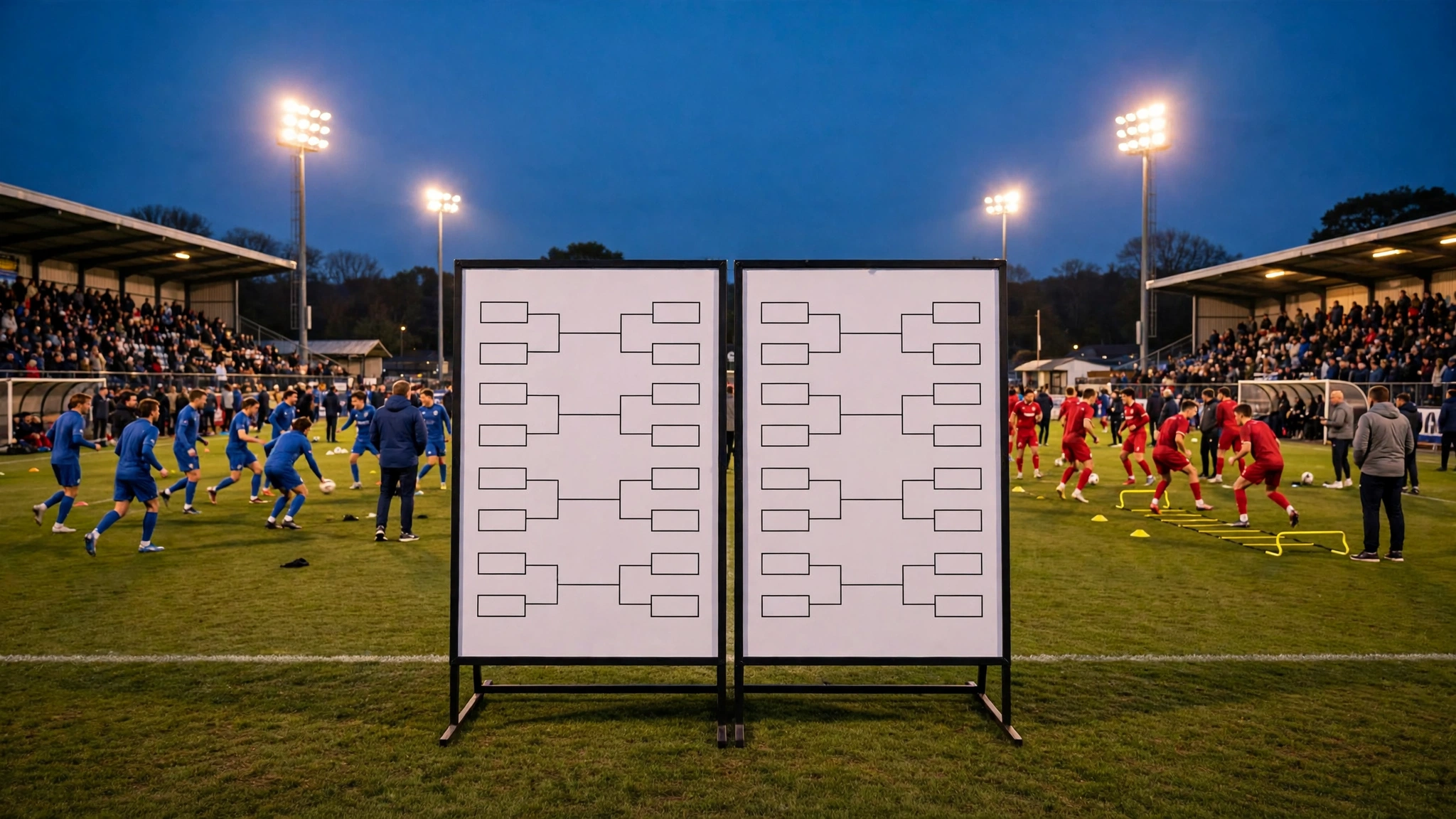
Every tournament starts with the same decision, and it shapes everything that follows: do teams play each other in a league-style round robin, or do they face one knockout match at a time in a single elimination bracket? Pick the wrong format and you get an event that drags on for hours, ends before lunch, or sends your strongest team home after one unlucky game. Pick the right one and the schedule, the games and the final all fall into place. Here is how each format works, how they compare, and a simple way to choose.
How single elimination works
Single elimination is the knockout format used in cup competitions and playoffs. Teams are paired in a bracket, the loser of each match goes home, and the winner advances until one champion remains. With 8 teams you get four quarter-finals, two semi-finals and a final: 7 games in total, always one less than the number of teams.
The format needs the field to fit a bracket of 4, 8, 16 or 32 slots. When your team count falls between those numbers, the spare slots become byes for the top seeds, which is standard practice and not a shortcut. If the details are new to you, our guide to what a bye is in a tournament explains how byes are counted and who receives them.
The strength of single elimination is drama. Every match matters, upsets are famous for a reason, and the whole event can finish in a single afternoon. The weakness is fairness: one bad game, one tough draw or one injured player can eliminate the best team before the final.
How round robin works
In a round robin, every team plays every other team once, and the standings decide the winner. There is no bracket and nobody is eliminated early. Points usually follow the familiar league pattern: 3 for a win, 1 for a draw, 0 for a loss, with goal difference or head-to-head results breaking ties.
The strength of round robin is fairness. Every team gets the same set of opponents, a single bad result rarely decides anything, and the final table reflects performance across the whole event. The weakness is scale: the number of games grows fast. The formula is teams multiplied by teams minus one, divided by two, so 6 teams need 15 games and 8 teams need 28. That is four times the games of a knockout with the same field, and many of the late matches can be dead rubbers between teams with nothing left to play for.
When the round robin wins, the next job is the fixture list itself: our walkthrough on how to make a round robin schedule gives the circle method with ready tables, and the Swiss format sits between the two, with round-robin fairness at near-elimination cost.
Side by side: the comparison that matters
| Factor | Single elimination | Round robin |
|---|---|---|
| Games needed | Teams minus 1 | Teams x (teams – 1) / 2 |
| Games with 4 teams | 3 | 6 |
| Games with 6 teams | 5 | 15 |
| Games with 8 teams | 7 | 28 |
| Time needed | Short: often one session or one day | Long: usually a full day or spread over weeks |
| Fairness | Lower: one bad game can knock out a strong team | Higher: everyone faces everyone, results even out |
| Drama | High: every match is win or go home | Lower per match, builds slowly in the table |
| Guaranteed games per team | 1 | Teams minus 1 (3, 5 or 7 in the examples above) |
| Best for | Cups, school events, fun days, large fields, tight schedules | Leagues, small fields, ranking players, season-long play |
Two rows in that table decide most real-world choices. The first is time: if you have one afternoon, a round robin with more than 6 teams is usually impossible. The second is guaranteed games: if players are travelling, paying entry fees or giving up a Saturday, a format that can send them home after one match needs a good reason behind it.
The hybrid: group stage, then knockout
You do not have to choose one format for the whole event. The most popular structure in sport, from the World Cup down to school tournaments, is a hybrid: split the field into small groups, play a short round robin inside each group, then send the top one or two teams from each group into a single elimination bracket.
With 8 teams, two groups of four produce 12 group games, then two semi-finals and a final. Every team is guaranteed at least three games, the strongest teams still reach the knockout rounds, and the day ends with a proper final instead of a table being read out. Our step-by-step walkthrough of how to organize a knockout tournament covers the bracket half of this structure in detail, including seeding and scheduling the rounds.
The hybrid costs more time than a pure knockout and needs the group draw handled honestly, but for fields of 8 to 16 teams with a full day available, it is usually the format players rate highest afterwards.
A simple decision guide
- You have under three hours: single elimination, whatever your team count.
- You have 4 teams and a full day: round robin, then a final between first and second if you want a showpiece match.
- You have 5 to 8 teams and one day: hybrid if time allows, single elimination if it does not.
- You have 9 to 16 teams: hybrid with groups of four, or straight knockout for a half-day event.
- Players are paying or travelling far: guarantee games. Round robin or hybrid, never a bare knockout.
- It is a league running for weeks: round robin, played once or twice through, is the natural fit.
- The crowd wants a spectacle: end with a knockout final, whichever format you start with.
One last check before you commit: count your venues or pitches, not just your hours. A round robin needs many games but they can run in parallel across pitches; a knockout bracket has fewer games but the final rounds always bottleneck onto one stage.
Once you have picked your format, the bracket is the easy part. Our free tournament bracket generator turns your team list into a seeded single elimination bracket in seconds, handles byes for the top seeds automatically, and lets you click winners through to the champion.