
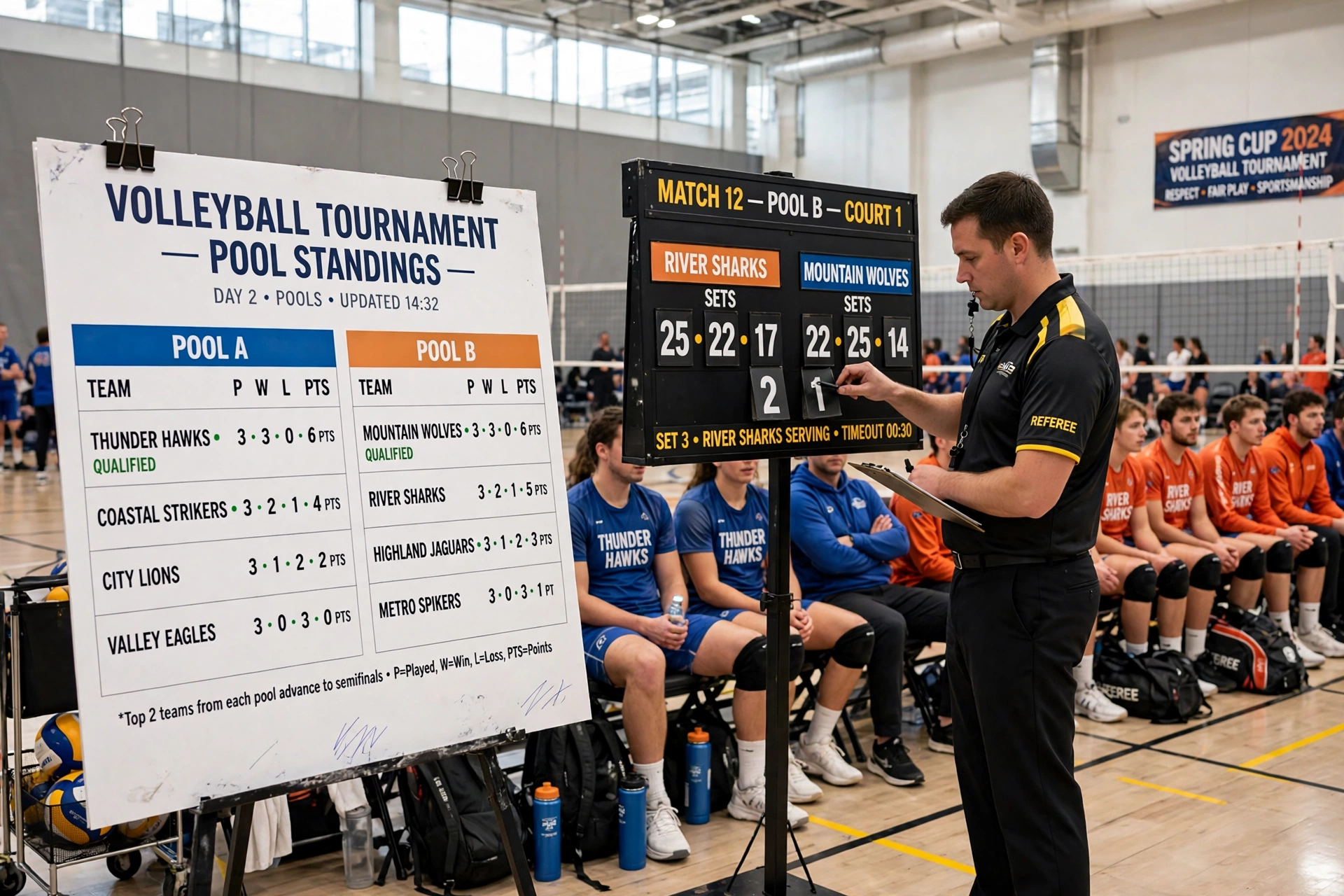
Pool play is the World Cup group stage shrunk to fit a Saturday. Teams are split into small groups called pools, everyone plays everyone else in their pool, and the standings, not one bad game, decide who reaches the final bracket. This guide covers how to size pools for fields of 8 to 32 teams, the tiebreaker order that settles level standings, a three-way tie worked out to the last point, and how the crossover seedings into the knockout round are set.
Why events use pool play
Three reasons, in the order organizers usually give them. First, guaranteed games: every team plays at least as many games as there are other teams in its pool, so nobody travels for a single match. Second, real seeding data: the final bracket is seeded by results earned on the day, not by reputation or last year’s guesswork. Third, forgiveness: one bad game damages a team’s standing instead of ending its tournament. The price is a longer day and more games to schedule. A pool is simply a small round robin, and our comparison of round robin vs single elimination works through the games math behind that trade-off in full.
Once the pools are drawn, the fixtures come from the same rotation as any league: how to make a round robin schedule has ready tables for pools of 4 and 6, and how many games are in a tournament totals the whole day, pools plus bracket.
Pool sizes for 8 to 32 teams
Pools of 4 are the default for a reason: three games per team, a table that usually separates itself, and a size that fits most schedules. Pools of 3 are quicker but produce more ties; pools of 5 give everyone four games and a long morning. The games in a pool follow one formula: teams in the pool times teams minus one, divided by two.
| Teams | Configuration | Pool games | Games per team |
|---|---|---|---|
| 8 | 2 pools of 4 | 12 | 3 |
| 12 | 3 pools of 4 | 18 | 3 |
| 12 | 4 pools of 3 | 12 | 2 |
| 16 | 4 pools of 4 | 24 | 3 |
| 20 | 4 pools of 5 | 40 | 4 |
| 20 | 5 pools of 4 | 30 | 3 |
| 24 | 6 pools of 4 | 36 | 3 |
| 32 | 8 pools of 4 | 48 | 3 |
Remember to add the knockout games on top. Sixteen teams in 4 pools of 4 play 24 pool games, and if the top two from each pool advance, the 8-team bracket adds 7 more, for 31 games on the day.
Standings and the tiebreaker chain
Level records are normal in pools of 3 and 4, so publish your tiebreaker order before the first game, and apply it in this sequence until the tie breaks:
- Head-to-head: the result of the game between the tied teams (or, with three or more tied, their results against each other).
- Point differential: points scored minus points conceded, across all pool games.
- Points scored: the higher total ranks ahead.
- Fewest points conceded: the tighter defense ranks ahead.
- Draw lots: a coin flip or a public draw, done in front of the captains.
Some events put point differential ahead of head-to-head. Either order is defensible; an unpublished order is not, because whichever team loses the argument will believe the order was chosen after the results were known.
A three-way tie, worked to the last point
Here is one pool of 4, all six results, in a points-scored sport:
| Game | Result |
|---|---|
| Harbor vs Metro | Harbor won 30 to 24 |
| Metro vs Union | Metro won 28 to 22 |
| Union vs Harbor | Union won 26 to 20 |
| Harbor vs Valley | Harbor won 35 to 15 |
| Metro vs Valley | Metro won 30 to 18 |
| Union vs Valley | Union won 29 to 21 |
| Team | Won | Lost | Points for | Points against | Differential |
|---|---|---|---|---|---|
| Harbor | 2 | 1 | 85 | 65 | +20 |
| Metro | 2 | 1 | 82 | 70 | +12 |
| Union | 2 | 1 | 77 | 69 | +8 |
| Valley | 0 | 3 | 54 | 94 | -40 |
Harbor, Metro and Union all finish 2 and 1, so the chain starts. Step 1, head-to-head: Harbor beat Metro, Metro beat Union, and Union beat Harbor. A perfect cycle, each team 1 and 1 against the other two, so the tie survives. Step 2, point differential: Harbor +20, Metro +12, Union +8. The tie breaks: Harbor takes first place in the pool, Metro second, Union third, and winless Valley fourth. Notice what decided it: the games against Valley, where Harbor’s 20-point win was the biggest margin of the three. That is exactly why many events cap the differential that counts per game, often at 15, so nobody profits from running up the score on the weakest team. Decide on a cap, or no cap, before the pools start.
Crossover seedings into the bracket
With two pools, the standard semifinals are 1A vs 2B and 1B vs 2A: each pool winner meets the other pool’s runner-up. Pool winners get the easier draw they earned, and nobody replays a pool opponent in the first bracket round. With four pools feeding an 8-team bracket, keep the same two principles: every pool winner plays a runner-up from a different pool, and two teams from the same pool cannot meet again before the semifinals.
The alternative is full reseeding: rank all the qualifiers by record, then by differential, and pair them 1 vs 8, 2 vs 7, 3 vs 6 and 4 vs 5. If that pairing recreates a pool rematch in the first round, swap the lower seed of that pairing with the lower seed of the next one. Both methods are covered in more depth in our guide to how to seed a tournament; pick one, publish it, and do not improvise on the day.
Uneven fields and wildcards
Fields rarely divide cleanly, and pool play handles that better than a straight bracket does. 10 teams: two pools of 5, 10 pool games in each, top two from each pool to the semifinals. No wildcard needed. 18 teams: four pools of 5, 5, 4 and 4, which is 10 + 10 + 6 + 6 for 32 pool games, with the top two from each pool making 8 quarterfinalists. 14 teams is the awkward one: four pools of 4, 4, 3 and 3 give you 4 pool winners, and the cleanest fix is a wildcard, taking the best runner-up (or the best two, if you want 6 qualifiers and byes for the top two pool winners).
Rank wildcards fairly, because the pools are different sizes. Compare runners-up by win percentage first: a runner-up who went 2 and 1 in a pool of 4 (a .667 win rate) ranks ahead of one who went 1 and 1 in a pool of 3 (.500), because the first earned more wins against more teams. Only if the win rates match do you move to point differential, and there you compare differential per game, not the raw total, so a team is not punished for playing fewer games.
When the pools finish, feed the qualifiers into the free tournament bracket generator in seed order, pool winners first, then runners-up, and it pairs them into the standard crossovers and handles any byes automatically. Publish the pool tables while the last games are still being played, and the bracket half of your day starts with a crowd that already believes the seedings.