
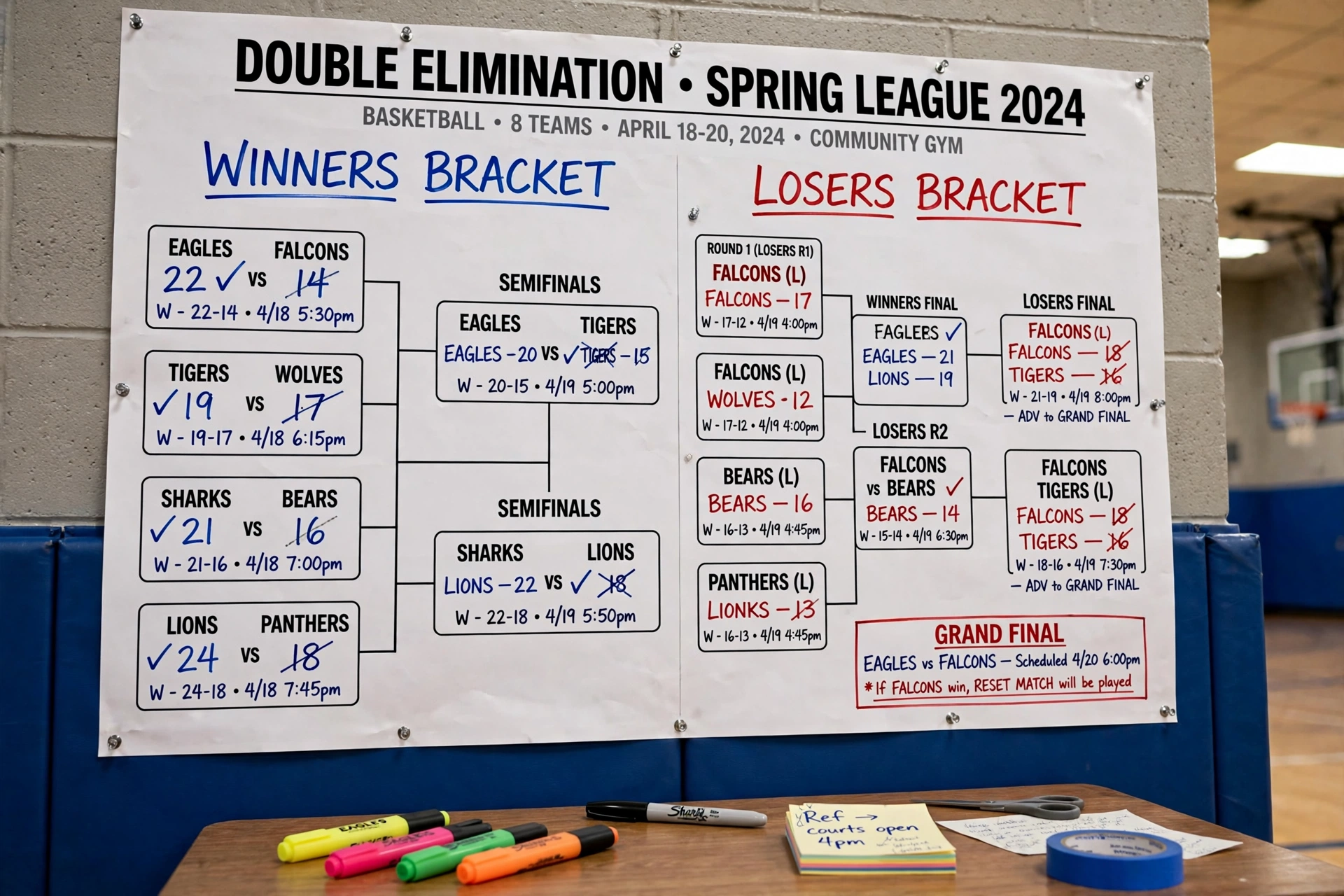
In a double elimination bracket, one loss does not send you home: you are only out when you lose twice. Every team starts in the winners bracket, drops into a losers bracket after its first defeat, and fights back toward a grand final against the last unbeaten team. It is the fairest of the knockout formats and the most misunderstood, mostly because the losers bracket looks complicated on paper. Traced match by match, it is actually a tidy system.
The anatomy: three parts
The winners bracket is an ordinary single elimination bracket. Win and you advance; lose and you drop down, carrying one loss.
The losers bracket is a second, smaller bracket fed entirely by teams that lost in the winners bracket, plus the teams already fighting there. Lose a second time, anywhere, and you are out.
The grand final pits the winners bracket champion, who has never lost, against the losers bracket survivor, who has lost once. That uneven record creates the format’s signature rule, the bracket reset: if the losers bracket team wins the grand final, both teams now have one loss, so a second, deciding final is played. If the unbeaten team wins the first grand final, the tournament ends on the spot.
How the drop-down pattern works
The secret is when and where losers arrive. First-round losers from the winners bracket enter losers round 1 and play each other, paired across the bracket so nobody immediately faces a team from their own quarter of the draw. Losers from later winners rounds arrive in later losers rounds, timed so the losers bracket has thinned to the right size to receive them, and crossed over so nobody drops straight into a rematch with the team that just beat them. Winners semifinal losers, for example, enter at losers round 2 in an 8-team bracket, crossed over: the semifinal 1 loser meets the losers round 1 winner from the other half. The whole structure exists to keep two things true at once: every match eliminates exactly one team for good or hands out a first loss, and no rematch happens a round after the original.
A full 8-team example
Eight teams, seeded 1 to 8: Apex (1), Blaze (2), Comet (3), Drift (4), Ember (5), Frost (6), Grove (7) and Harbor (8).
Winners bracket, quarterfinals: Apex beats Harbor, Ember upsets Drift, Blaze beats Grove, Comet beats Frost. The four losers, Harbor, Drift, Grove and Frost, drop to losers round 1 with one loss each.
Winners semifinals: Apex beats Ember, and Comet upsets Blaze. Winners final: Apex beats Comet. Apex is the winners bracket champion, unbeaten. Comet drops down with its first loss, and waits deep in the losers bracket.
Losers round 1: Drift beats Harbor, Grove beats Frost. Harbor and Frost are out, with two losses each.
Losers round 2: the semifinal losers arrive, crossed over: Ember (who lost to Apex) meets Grove, and Blaze meets Drift. Grove beats Ember, Drift beats Blaze. Ember and Blaze are out.
Losers round 3: Grove vs Drift, the two survivors play, and Drift wins. Grove is out.
Losers round 4: Drift meets Comet, the winners final loser, in the losers bracket final. Drift wins again. Comet is out with its second loss.
Grand final: Apex (no losses) vs Drift (one loss, and four straight losers bracket wins). Drift wins a thriller, so both teams stand at one loss and the reset is triggered. Reset final: Apex wins the rematch and takes the title. Drift’s run ends with 5 wins and 2 losses from 7 games, and every other team also finished with exactly two losses, which is how you can check any double elimination result: only the champion may end with fewer.
The game count, and what it costs you
Count the example: winners bracket 7 games (4 quarterfinals, 2 semifinals, 1 final), losers bracket 6 games (2 + 2 + 1 + 1 across its four rounds), grand final 1, reset 1. Total: 15 games, and it would have been 14 if Apex had won the first grand final. The general formula is 2N-2 games, plus one when the reset happens. Against single elimination’s 7 games for the same 8 teams, you are paying roughly double the court time, and the tail is long: the losers bracket has more rounds than the winners bracket, so the end of the day bottlenecks while early finishers wait. Budget the day around those losers rounds, because they, not the winners bracket, decide when the grand final can start. Non-power-of-two fields cost no extra games in total, by the way: the byes sit in the winners bracket first round, exactly as described in our explainer on what a bye is in a tournament, and the count still lands on 2N-2 or 2N-1.
The full count table for every field size is in how many games are in a tournament, and if double elimination feels too heavy, a consolation bracket buys most teams a second game at a third of the cost.
When double elimination is worth it, and when it is not
Use it when the field is small and serious, when teams have traveled or paid to play, and when a single bad game deciding everything would feel wrong: esports events, championship playoffs, club finals days with 4 to 8 teams and courts to spare. Skip it for large fields, tight schedules and first-timer events. Sixteen teams means 30 games and a long day even with several courts, and explaining the losers bracket to casual players eats the time you saved. For fields like that, pool play into a single elimination bracket gives most teams several games at half the organizational cost, which is the route our guide on how to organize a knockout tournament recommends for one-day events.
One honest note about our own tools: the free Tournament Bracket Generator on this site builds single elimination brackets, not double elimination. It is the right tool for straightforward knockout events and for the playoff stage after pools or a losers bracket played on paper, and it handles seeding and byes automatically. If your whole event is double elimination, run the winners bracket side with it if you like, but keep the losers bracket on a printed chart where everyone can watch the drop-downs happen.