
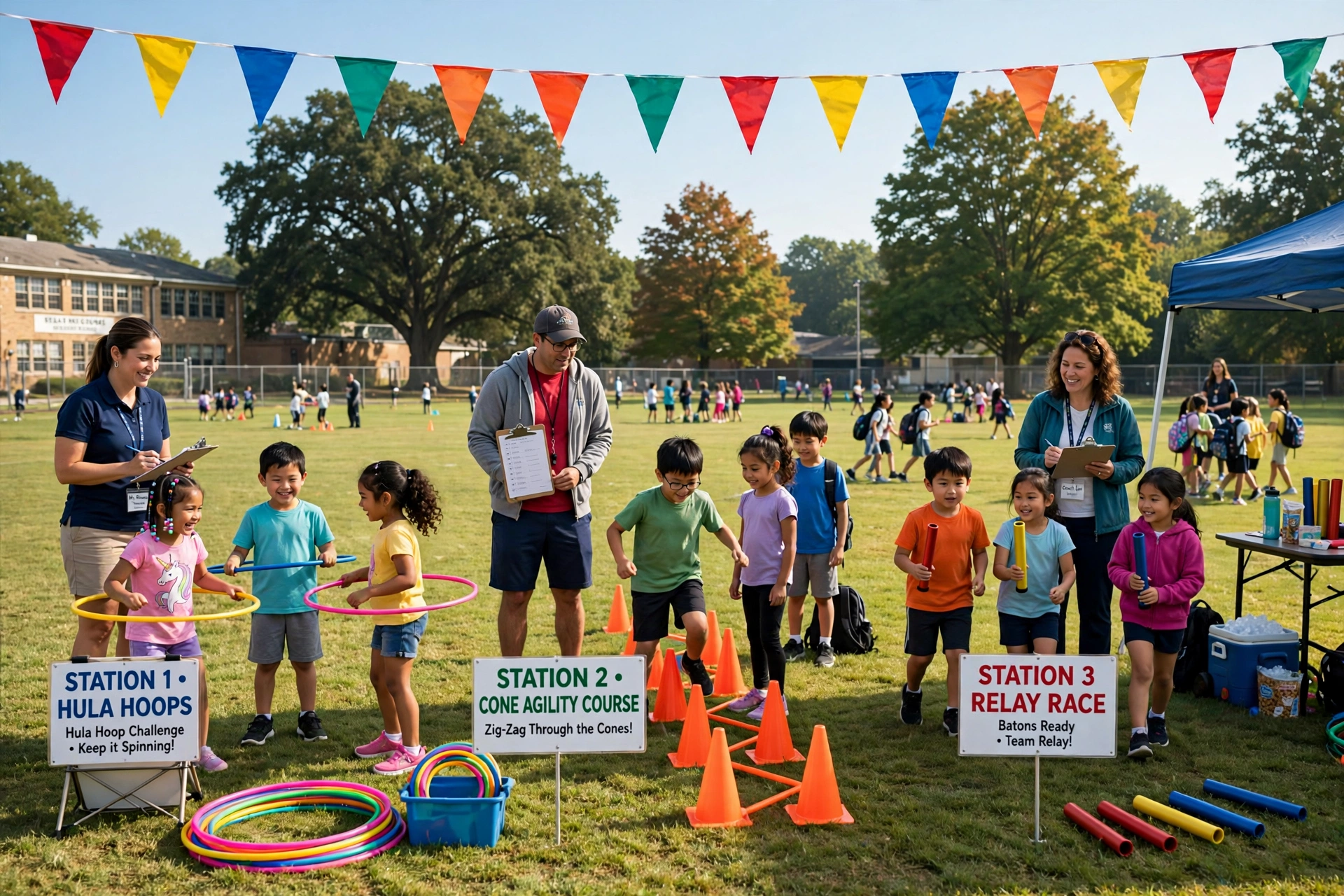
A field day runs on arithmetic, not enthusiasm. If the rotation math is wrong, three hundred children queue at one station while the parachute sits empty, and no amount of cheerful announcing fixes it. This guide does the math first, works one complete example with 12 classes and 12 stations, then covers stations, volunteers and the problems that actually happen.
The math first: stations, blocks and group sizes
Three numbers run the whole event. Stations equal classes. If 12 classes are coming, you need 12 stations, because in every block each class is at exactly one station. Blocks equal stations. For every class to visit every station, the rotation needs as many blocks as there are stations: 12 blocks here. Block length comes from your clock. Divide the time you have by the blocks you need.
The worked example: give each block 10 minutes of activity plus 2 minutes to move, so a block is 12 minutes. Twelve blocks times 12 minutes is 144 minutes of rotations, 2 hours and 24 minutes. Add a 15-minute opening and a 15-minute closing and the event is 8:45 to 11:40: opening 8:45 to 9:00, rotations 9:00 to 11:24, closing awards 11:24 to 11:40. If your window is shorter, shrink the activity time per block, not the number of blocks, or some classes will miss stations.
Group size is the last number. A station receives one whole class at a time, usually 20 to 30 children, which most activities handle if the station runs two or three mini-games inside it. If your classes are bigger than about 24, split each class into two squads that travel together and take half the station each. If you need to build fresh mixed groups instead of traveling as classes, that is a grouping job covered in our guide to how to divide a class into groups.
The rotation, worked in full
The rotation rule is one sentence: in every new block, each class moves to the next station number, and the class at Station 12 wraps around to Station 1. Here are the first three blocks in full:
| Class | Block 1 (9:00) | Block 2 (9:12) | Block 3 (9:24) |
|---|---|---|---|
| Class 1 | Station 1 | Station 2 | Station 3 |
| Class 2 | Station 2 | Station 3 | Station 4 |
| Class 3 | Station 3 | Station 4 | Station 5 |
| Class 4 | Station 4 | Station 5 | Station 6 |
| Class 5 | Station 5 | Station 6 | Station 7 |
| Class 6 | Station 6 | Station 7 | Station 8 |
| Class 7 | Station 7 | Station 8 | Station 9 |
| Class 8 | Station 8 | Station 9 | Station 10 |
| Class 9 | Station 9 | Station 10 | Station 11 |
| Class 10 | Station 10 | Station 11 | Station 12 |
| Class 11 | Station 11 | Station 12 | Station 1 |
| Class 12 | Station 12 | Station 1 | Station 2 |
Blocks 4 to 12 follow the same rule, so in Block 12 every class reaches the one station it has not visited yet, and no class ever doubles up or waits. Generate the full grid from the rule, print one copy per teacher and per station leader, and put the station numbers on signs big enough to read across a field.
The station menu, by age band
Two of your twelve stations are not games, and they are not optional: a water and shade stop (cups, a filled water container, somewhere to sit) and a free-play station (balls, hoops and chalk, loosely supervised). They are pressure valves: they reset energy and tempers, and absorb any class whose station is being repaired.
For kindergarten to grade 2, keep everything short, wet or bouncy:
- Parachute games (one parachute): waves, popcorn with soft balls, cat and mouse underneath.
- Sponge relay (sponges, two buckets per team): carry water from full bucket to empty, measure the result.
- Bubble station (wands and bubble mix).
- Mini obstacle course (cones, hoops, a tunnel): over, under, through, and back to tag the next runner.
- Beanbag target toss (beanbags, hoops on the ground): points by hoop, everyone throws, nobody is out.
For grades 3 to 5, add competition and teamwork:
- Three-legged race (soft ties or bands): pairs down the lane and back.
- Tug of war (a rope and a center line): the station leader matches sizes honestly.
- Baton relay (batons, cones): a proper sprint relay around a marked loop.
- Long-rope jumping (one long rope, two adult turners): how many jumpers can the rope hold at once.
- Mini capture the flag (flags or bibs, a coned-off field): two half-classes, five-minute games.
If squads travel mixed-age or you split classes, give each squad a name before the day: rotations run smoother when a marshal can call a name instead of a room number, and the classroom team names page has ready-made lists by style.
The planning timeline
| When | Jobs |
|---|---|
| 8 weeks out | Fix the date and a rain date, book the field, count classes and set the station count. |
| 4 weeks out | Recruit volunteers, at least one leader per station plus spares. Choose stations, list equipment, order ribbons and certificates. |
| 1 week out | Print grids and signs, confirm every volunteer by name, check the first aid kit, send class lists to leaders. |
| Day before | Mark stations with cones and signs, stage equipment, agree the rain decision time. |
| Morning of | Leaders at their stations 30 minutes early. Fill water containers. Test the whistle or PA signal. Opening at 8:45. |
Volunteer roles
| Role | How many | The job |
|---|---|---|
| Station leader | 12 | Runs one station all day: teaches the game in 30 seconds, resets equipment, keeps the block moving. |
| Rotation marshal | 2 | Blows the move signal, walks the grid, unblocks jams and finds lost classes. |
| Water and first aid | 2 | Staffs the fixed first aid and water point, keeps the log of every visit, has a phone to the office. |
| Timekeeper and MC | 1 | Owns the clock and the announcements, runs the opening and the closing. |
| Floater | 2 | Covers leader breaks, delivers water, escorts any child who needs the office or the bathroom. |
That is 19 adults for a 12-station day, on top of the teachers who travel with their classes. If you are short, cut stations and classes together rather than leaving a station unled: an unled station becomes a crowd within one block.
When things go wrong
First aid. One fixed point, in one signed place, all day. Station leaders send a runner or call a floater; nobody sends an injured child walking alone. Log every visit, however small, with the time and the class.
Lost children. Teach the rule at the opening: stop, stay, shout. A child who notices they are lost stays where they are and calls out; marshals sweep the grid and bring them to the MC point. The real safeguard is a headcount at every move: the teacher counts the class out of one station and into the next, because the 2-minute move is when children drift.
Rain. Decide by a fixed time, 7:00 in the morning here, and announce it once. The indoor fallback keeps the same grid with half the stations: pair the classes up, run 6 stations and 6 longer blocks in the gym and halls, and accept a shorter day. Or call the rain date. Either is fine; deciding on the day, in the rain, is not.
Awards that include everyone. Give every child a station passport card, stamped at each station they visit: a full card is the souvenir, and it quietly proves they did everything. Add a participation certificate for all, plus a few noticed awards: best teamwork, loudest cheer, kindest class. Nobody should leave empty-handed.
If your classes travel as mixed squads rather than whole rooms, build those squads with the free random group generator: paste the class list, set the squad size, add any keep-apart pairs, and every squad on the rotation is even before the first whistle blows.