
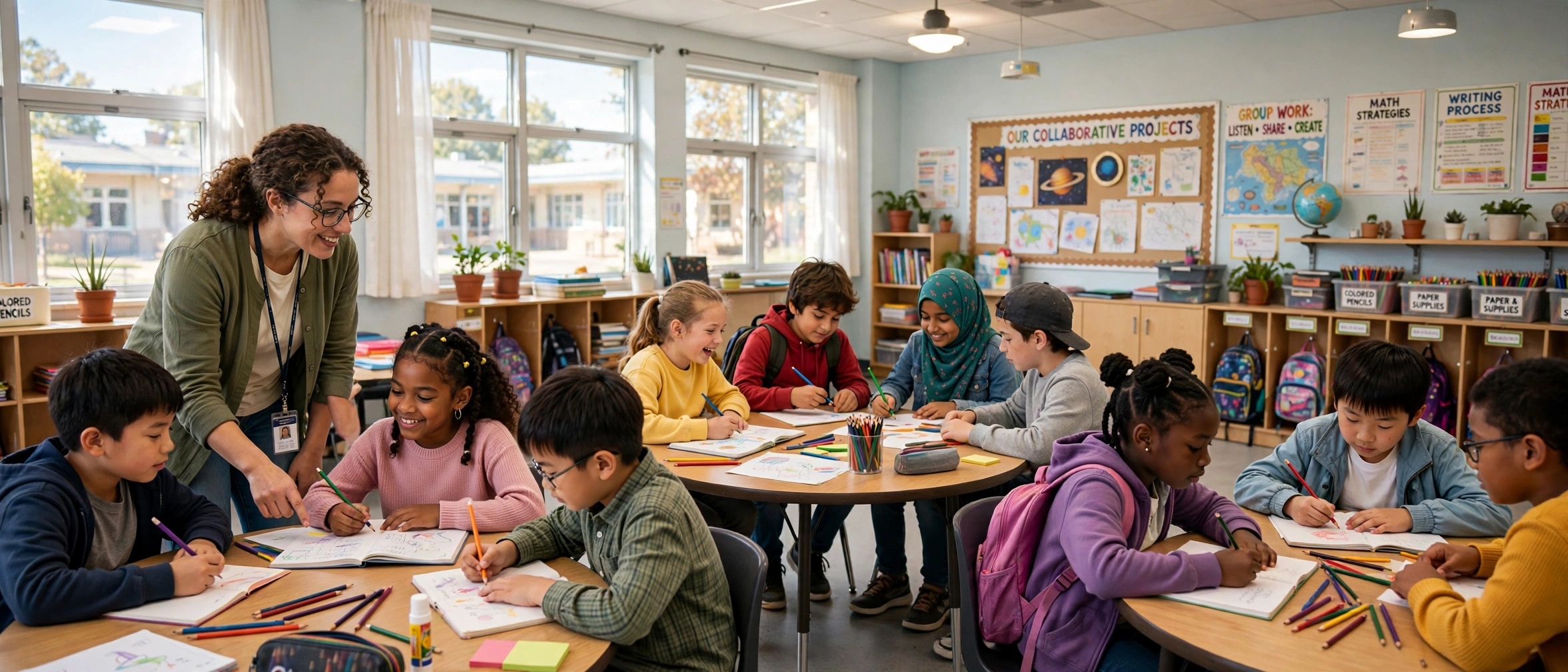
Every teacher knows the moment. You announce group work, and the room splits into best friends locking eyes across the class while two or three students quietly hope someone will want them. Friendship groups feel kind, but they cause most of the drama: one group of friends chats instead of working, a leftover student gets adopted by nobody, and the student who is always picked last remembers it. There is a better way to divide a class into groups, and it starts with removing the choosing.
Why random groups beat friendship groups
When students pick their own groups, they sort by popularity, not by learning. The same strong students cluster together, the same struggling students cluster together, and the teacher ends up with one group that finishes in five minutes and one that never starts. Random grouping breaks that pattern in three ways.
- Fairness nobody can argue with. A draw or a shuffle has no favourites. Students may not love their group, but they cannot claim the teacher rigged it.
- Better mixes. Random groups spread ability, confidence and energy across the room, so every group has someone who reads well, someone who organises and someone who asks questions.
- Social range. Over a term, students work with classmates they would never choose, which quietly widens friendship circles and cuts down cliques.
The trick is to make the randomness visible. Draw names from a pot, project a shuffled list, or deal names out like cards. When students can see the process is blind, complaints drop to almost nothing.
Pick the group size by age and task
Group size matters more than the method. A group that is too small stalls when one student is absent or stuck; a group that is too big hides passengers.
| Age | Good size | Why |
|---|---|---|
| 5 to 7 | 2 to 3 | Short attention spans; pairs and trios keep everyone involved. |
| 8 to 11 | 3 to 4 | Enough hands for practical tasks, small enough that nobody drifts. |
| 12 to 14 | 3 to 4 | Social friction peaks here; fours work, fives invite a spectator. |
| 15 plus | 4 to 5 | Older students can split a bigger task into real roles. |
Then adjust for the task itself. Discussion and reading work in threes. Practical work, experiments and building tasks suit fours, because there are materials to hold and jobs to share. Presentations can take fives if each student has a defined section. Whatever size you choose, keep the sizes within one of each other: a class of 25 in groups of 4 becomes four groups of 4 and three groups of 3, never a leftover group of 1.
Handle keep-apart and keep-together pairs before you draw
Pure randomness occasionally puts two students together who should never be in the same group: the pair who derail each other, or the two who fell out at lunch. It can also separate a new student from the one friendly face they know, or split a support arrangement that genuinely helps. Handle these cases as rules set before the draw, not as fixes after it.
- Keep apart: two students who wind each other up, or two dominant students who silence everyone else.
- Keep together: a new student and their buddy, a student and the classmate who helps them access the work, siblings in a small class activity where separating them causes more fuss than it saves.
Keep the list short. Two or three rules per class is plenty; a draw bent by twenty exceptions is no longer random, and students can tell. The fairness principles behind this are the same ones used for teams: the method, and the reasons it stays honest, are laid out in our guide to splitting teams fairly.
Give every group member a role
Most group work drama is really role drama: one student does everything, one does nothing, and both resent it. Assign roles inside each group and rotate them between lessons. A reliable set of four is facilitator (keeps the group on the task and the clock), recorder (writes down what the group decides), reporter (presents back to the class) and checker (makes sure everyone understands and agrees before the group moves on). In threes, merge checker into facilitator. Roles give quiet students a sanctioned way in and give dominant students a job that is not “do it all”.
Reshuffle between lessons, not during them
Fresh groups for every new topic or project keeps the social mixing working and stops a bad group from becoming a term-long sentence. Within a project, keep groups stable so the work can build. A workable rhythm is: new draw at the start of each unit, roles rotate every lesson, and one mid-unit reshuffle only if a group is genuinely stuck. Reshuffling mid-lesson because a student complains teaches the class that complaining works, so hold the line kindly: this is your group for this task, and the next draw comes on Friday.
Answering the fairness complaints
You will still hear three complaints. “Miss, he always gets the good group” is answered by the visible draw: nobody arranged it. “We work better with our friends” is answered honestly: probably true, and that is why friend groups finish fast and learn less; group work at school is partly practice for working with whoever life assigns you. “This group is not fair, they have all the clever ones” usually means one group looks strong on paper; point out that the draw spread everyone blindly, and that roles, not reputations, decide how a group performs. When students trust the method, the complaints fade within a few weeks.
Doing this by hand with lollipop sticks works, but it eats minutes and cannot respect keep-apart rules. Our free Random Group Generator was built for exactly this: paste your class list, choose groups by size or by count, add keep-apart and keep-together pairs, and reshuffle in one click when someone is absent. And when a group needs a name before it starts, the classroom team names page gives every group an identity the class will actually enjoy using.