
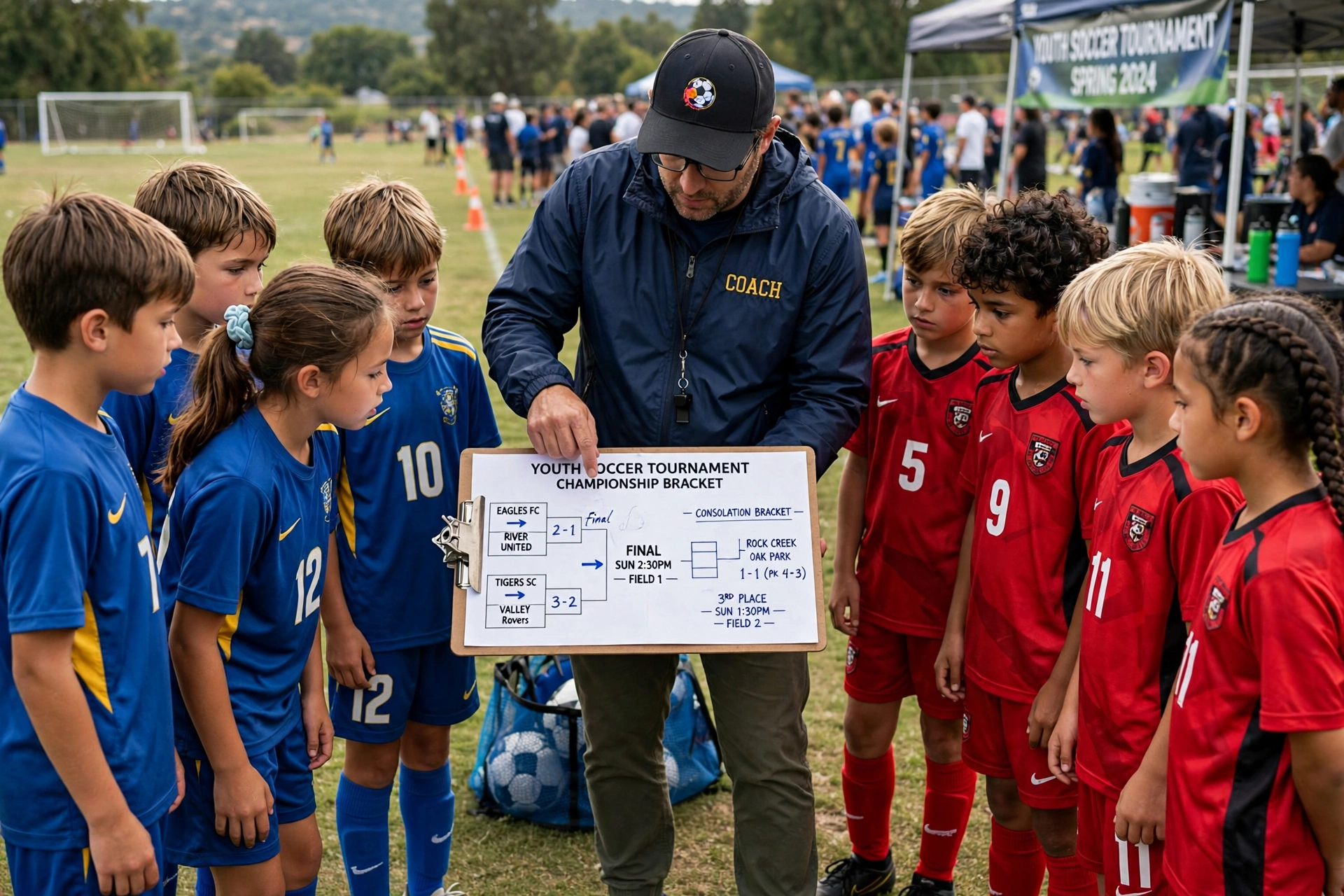
“Consolation bracket” causes more arguments than any other term in tournament planning, because it names two different formats. One drops first-round losers into a second bracket that plays out to a consolation champion. The other runs after pool play and places every team from first to eighth. They cost different amounts of time and answer different complaints, so here is each format worked with a real 8-team bracket, plus what each one adds to your day.
Type 1: the losers’ bracket (the classic consolation)
Start with a standard 8-team single elimination bracket, the format covered step by step in our guide to how to organize a knockout tournament. That bracket is 7 matches: 4 quarterfinals, 2 semifinals and a final. Half the field loses its first game and, in a plain knockout, goes home after one match. The consolation bracket exists for those four teams.
The four quarterfinal losers drop into a consolation semifinal round, and the winners meet in a consolation final. Work it with seeds. Say the quarterfinals finish 1 beats 8, 4 beats 5, 2 beats 7 and 3 beats 6. The losers are seeds 8, 5, 7 and 6. Pair them in bracket order: seed 8 plays seed 5, and seed 7 plays seed 6. If 5 and 6 win those games, the consolation final is seed 5 against seed 6, and its winner is the consolation champion, effectively fifth place in the tournament.
The guarantees are the selling point. Every team in the event plays at least two games: a quarterfinal, plus at least a consolation semifinal for the losers. The cost is small: 2 consolation semifinals plus 1 final is 3 extra matches, for a tournament total of 10 instead of 7.
One optional extra: a seventh-place game between the two consolation semifinal losers. That is 1 more match, 11 in total, and it places all eight teams exactly. Without it, the two teams that lose the consolation semifinals simply tie for seventh. Add the game if places matter for league standings or next year’s seeding; skip it if the day is already long.
Scheduling the extra games is easier than organizers expect. The consolation semifinals involve teams already eliminated from the main bracket, so they can start the moment the quarterfinals finish, on any court the main semifinals are not using. Announce the consolation final with the same ceremony as the real final, on the best court if it is free. Teams whose extra games were treated as real games come back next year. Teams whose consolation final was squeezed onto a side court while nobody watched remember that instead, and some of them stay home.
Type 2: the placement bracket after pool play
The second format belongs to events that start with groups. Take 8 teams in 2 pools of 4: the pools take 12 games, and the standings give you a first, second, third and fourth in each pool. Instead of sending only the top two into a knockout and the rest home, every team crosses over into a placement game in one of two tiers.
If the group stage itself is new to you, pool play explained covers pool sizes, standings and the tiebreaker order that feeds this bracket.
| Tier | Semifinal 1 | Semifinal 2 | Final | Placement game |
|---|---|---|---|---|
| Places 1 to 4 | Pool A 1st vs Pool B 2nd | Pool B 1st vs Pool A 2nd | Winners play for 1st and 2nd | Losers play for 3rd and 4th |
| Places 5 to 8 | Pool A 3rd vs Pool B 4th | Pool B 3rd vs Pool A 4th | Winners play for 5th and 6th | Losers play for 7th and 8th |
Each tier is 4 games: 2 semifinals, a final and a placement game. Two tiers make 8 placement matches, and the whole event is 12 pool games plus 8 placement games, 20 matches in total. Every team plays 2 placement games on top of its 3 pool games, so every team finishes the day with at least 5 games and an exact final place, first through eighth, with no ties anywhere.
What each type costs
| Format | Extra matches | Extra time on one court (about 25 min a game) |
|---|---|---|
| Type 1, plain | 3 | About 75 minutes |
| Type 1, with seventh-place game | 4 | About 100 minutes |
| Type 2, full placement | 8 | About 200 minutes (3 hours 20) |
Courts divide those times. Type 1’s three games usually run alongside the main bracket’s semifinals and final, so with one spare court they can cost almost no clock time at all. Type 2’s eight games on two courts take about 100 minutes of wall-clock time, not 200. The other cost nobody budgets for is awards: a consolation final usually gets medals or a trophy in youth events, so add a small line for extra hardware.
One wrinkle before you promise either format: odd fields. If your entry list is not a clean 8 or 16, byes change who counts as a first-round loser, because a team that receives a bye has not played yet when the first round ends. Our explainer on what a bye is in a tournament shows how the numbers shift; settle the consolation rule for bye teams in writing before the draw.
When it is worth it, and when it just makes the day longer
Run a consolation bracket when games are the product. Youth tournaments are the clearest case: children develop by playing, and parents who drove an hour accept a first-round loss far better when a second game is guaranteed. The same logic covers any team that travelled or paid a real entry fee. Placement games also produce honest fifth-to-eighth rankings, which are exactly the data you want when seeding next year’s event.
Skip it when the clock is the product. If the venue booking is tight, if the main bracket already ends near dark, or if your crowd is an adult social field that honestly prefers the barbecue to a fifth-place game, a consolation bracket turns a good day into a long one. A useful test: if the losing teams would rather stay, add the bracket; if they would rather leave, believe them.
Whichever type you choose, build the main bracket first with the free tournament bracket generator, then sketch the consolation half on the same sheet. In a Type 1 event the losers’ semifinals are decided the moment the quarterfinals end, and a bracket the whole venue can read is a bracket nobody argues with.