
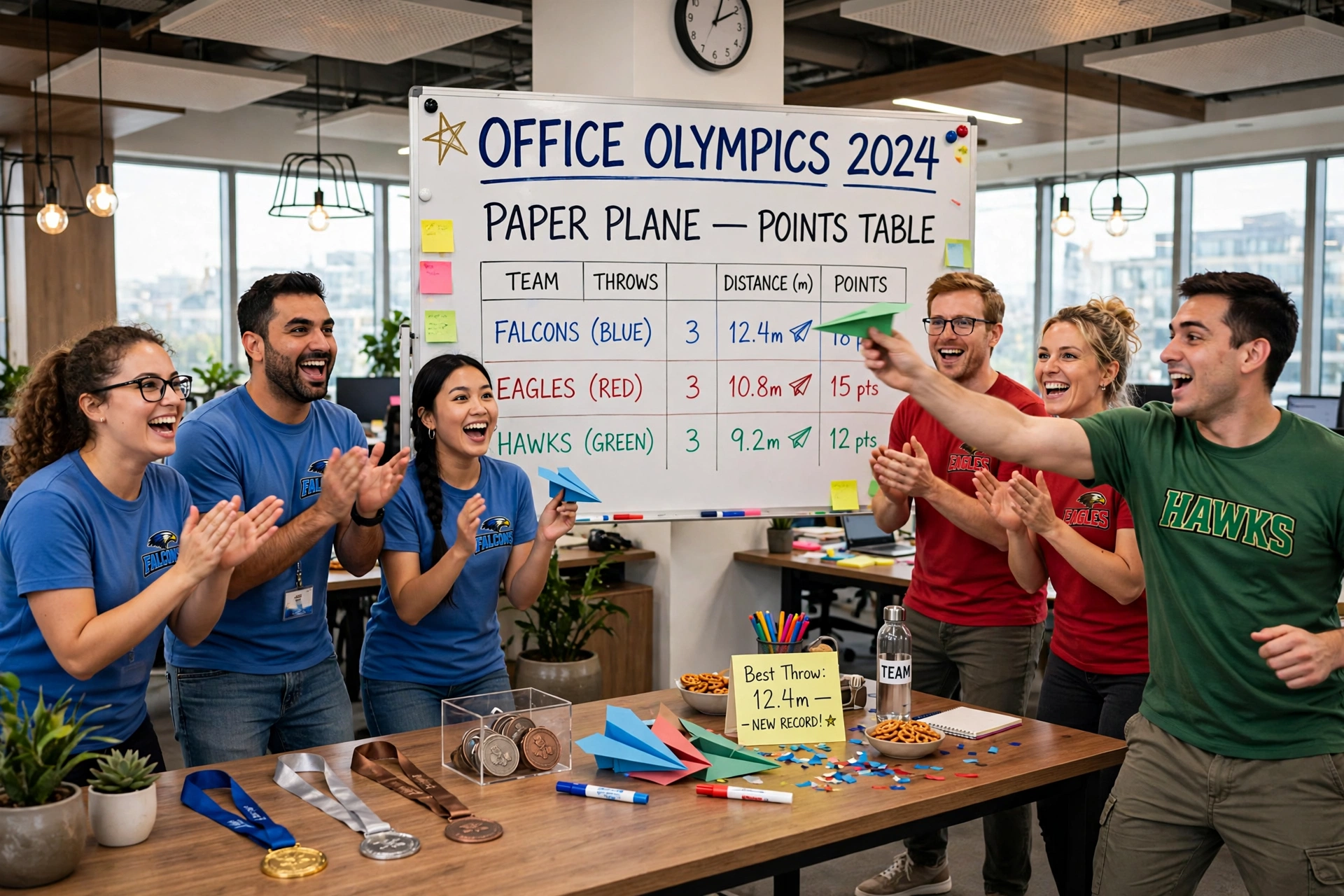
Office Olympics fail in two predictable ways: events only the athletic enjoy, and a scoring argument at the awards. This plan fixes both. Teams are mixed on purpose and picked by nobody, the ten events can be won by any fitness level, and the points system is written down before the first paper ball is thrown. Everything here fits inside a normal workday, in a normal office, with equipment you already own.
Form the teams first, and form them on purpose
Use teams of 4 to 6 people. Deliberately mix departments, floors and seniority: a team drawn from one department turns the day into a grudge match, and the sales-versus-warehouse final writes itself in the worst way. Keep the same teams for every event, because the master scorecard depends on it.
Do not use captains. A public pick ranks colleagues in front of each other, and the last person chosen remembers it at the Christmas party. Deal the names out, draw them from a hat, or generate the teams: the method matters less than the fact that nobody chose. Our breakdown of how to pick teams without captains compares five fair methods if you want the reasoning before the day.
The 10 events
At the desk
- Bin basketball. Tape a line 3 meters from a waste bin. Each player gets 5 crumpled paper balls; every shot that lands and stays in scores 1. Add the team’s shots together. Equipment: bin, tape, paper.
- Typing relay. Put the same short paragraph on every screen. Each member types it once, one after another; score is total time plus 5 seconds per error. Equipment: laptops and one prepared paragraph.
- Rubber-band archery. Stack 6 paper cups as a tower 2 meters away. Each player fires 5 rubber bands; score the cups knocked off the desk. Equipment: rubber bands, cups, and a shooting direction that points away from faces.
On the floor
- Paper plane distance. One sheet of A4 per player and 5 minutes to fold. Each player throws once down a corridor or hall; the team’s score is its two best distances added together. Equipment: paper and a tape measure.
- Balloon keep-up. The whole team stands in a circle with one balloon. Count the touches in 2 minutes before it touches the floor; catching or holding ends the count. Equipment: balloons, plus spares for the inevitable casualty.
- Sticky-note sprint relay. Each runner sprints to a wall chart, sticks one note in the team column and tags the next runner. Most notes stuck in 3 minutes wins; a note that falls off does not count. Equipment: sticky notes and a chart with one column per team.
- Office chair slalom. Pairs race a cone course, one riding and one pushing, one lap each. Team score is total time. Safety is the whole game here: tape the lane, keep it clear of bags and cables, the pusher walks and never runs, and the rider keeps feet on the footrests. Equipment: wheeled chairs and cones.
- Statue freeze. The chair-freeze idea without the chairs: music plays and everyone dances; when it stops, freeze. Anyone caught moving sits out the round. After 5 rounds, a team’s score is its players still standing. Equipment: a speaker and a referee with no mercy.
Outside, or anywhere with floor space
- Water-bottle bowling. Six filled bottles stand as pins 5 meters away. Each player rolls a tennis ball twice; count the pins, and reset between players. Equipment: bottles, a tennis ball and tape for the line.
The finale: a trivia tiebreak round
- Team trivia. Ten questions, mixed topics, written answers, one point each. Score it like every other event, by placement. It doubles as the official tiebreak: if the overall standings are level after ten events, the trivia winner takes the day, no coin flips and no arguments. Equipment: questions, paper, pens.
The scoring system
Every event pays placement points. With six teams in an event, the table is:
| Placement | 1st | 2nd | 3rd | 4th | 5th | 6th |
|---|---|---|---|---|---|---|
| Points | 10 | 8 | 6 | 4 | 2 | 1 |
The last team gets 1 point just for finishing, so nobody is ever playing for zero. When an event has a different number of teams, scale with one formula: points = 10 × (teams in the event − your placement) ÷ (teams in the event − 1), rounded to the nearest whole number, with a minimum of 1 for finishing. Check it against a four-team event: the formula gives 10, 7, 3 and 1, which keeps first place worth the same everywhere and stops small events handing out cheap third places.
One more normalization, for team size. In events where every player takes a turn (bin basketball, bowling), a six-person team outscores a four-person team on volume alone. So divide the team’s total by the number of players who took a turn and score the average instead. The scorecard below uses the six-team table across four events:
| Team | Bin basketball | Paper planes | Chair slalom | Trivia | Total |
|---|---|---|---|---|---|
| Alpha | 10 | 6 | 8 | 10 | 34 |
| Beta | 8 | 10 | 6 | 4 | 28 |
| Gamma | 6 | 8 | 10 | 8 | 32 |
| Delta | 4 | 4 | 4 | 6 | 18 |
Copy that grid onto a whiteboard or a big sheet where everyone can see it, and update it after every event. A public scorecard is the difference between suspense and suspicion.
Two plans that fit a workday
Half-day plan, 5 events, about 2.5 hours:
| Time | What happens |
|---|---|
| 9:00 to 9:15 | Team draw, rules, scorecard on the wall |
| 9:15 to 9:40 | Bin basketball |
| 9:40 to 10:05 | Paper plane distance |
| 10:05 to 10:15 | Break |
| 10:15 to 10:40 | Balloon keep-up |
| 10:40 to 11:05 | Water-bottle bowling |
| 11:05 to 11:25 | Trivia finale |
| 11:25 to 11:35 | Awards |
Full-day plan, all 10 events:
| Time | What happens |
|---|---|
| 9:00 to 9:20 | Team draw, rules, scorecard on the wall |
| 9:20 to 9:45 | Bin basketball |
| 9:45 to 10:10 | Typing relay |
| 10:10 to 10:35 | Rubber-band archery |
| 10:35 to 10:50 | Break |
| 10:50 to 11:15 | Paper plane distance |
| 11:15 to 11:40 | Balloon keep-up |
| 11:40 to 12:25 | Lunch |
| 12:25 to 12:50 | Sticky-note sprint relay |
| 12:50 to 13:15 | Office chair slalom |
| 13:15 to 13:40 | Statue freeze |
| 13:40 to 13:55 | Break |
| 13:55 to 14:20 | Water-bottle bowling |
| 14:20 to 14:40 | Trivia finale |
| 14:40 to 15:00 | Awards |
Awards that are not just first place
Four awards cover the room. The champions take the trophy and the glory. Best Team Name rewards the funniest entry on the scorecard, and if your teams are stuck for one, shortlist a few from the work team names page before the draw. Most Spirited goes to the loudest, kindest team, judged by the referee. And the Wooden Spoon, presented with full ceremony, goes to last place: the team that finishes last with a speech ready is the team people remember. Keep prizes small and slightly silly: coffee vouchers, the good parking spot for a week, or first pick of the meeting snacks.
Start where every good Office Olympics starts, with teams nobody can complain about: paste the staff list into the free random team generator, set teams of 4 to 6, use the keep-apart rules to mix departments on purpose, and print the team lists before you print anything else. Fair teams, written-down points, and a scorecard on the wall: the day runs itself from there.